

The car is sideways at 100 km/h. This is fine. This is completely intentional.Please stop screaming.
Drift racing has an image problem. To the uninitiated, it looks like someone took a perfectly good race car, pointed it at a corner, and then had a small argument with their own nervous system about which direction to go. Tire smoke everywhere. Loud noises. The car appears to be attempting several directions at once.
Here is the thing: every single bit of that is deliberate. The smoke is calculated. The angle is set. And the driver — who looks, from the outside, like they are experiencing a vehicular emergency — is actually solving a continuous multi-variable physics problem faster than most people can process what they’re watching.
Dismissing drift as spectacle reveals a misunderstanding of the forces involved. Let’s fix that with science, and also some tire budget math that would make any team accountant weep quietly.
The Physics Foundation: Why Cars Oversteer (Spoiler: Tires Are Liars)
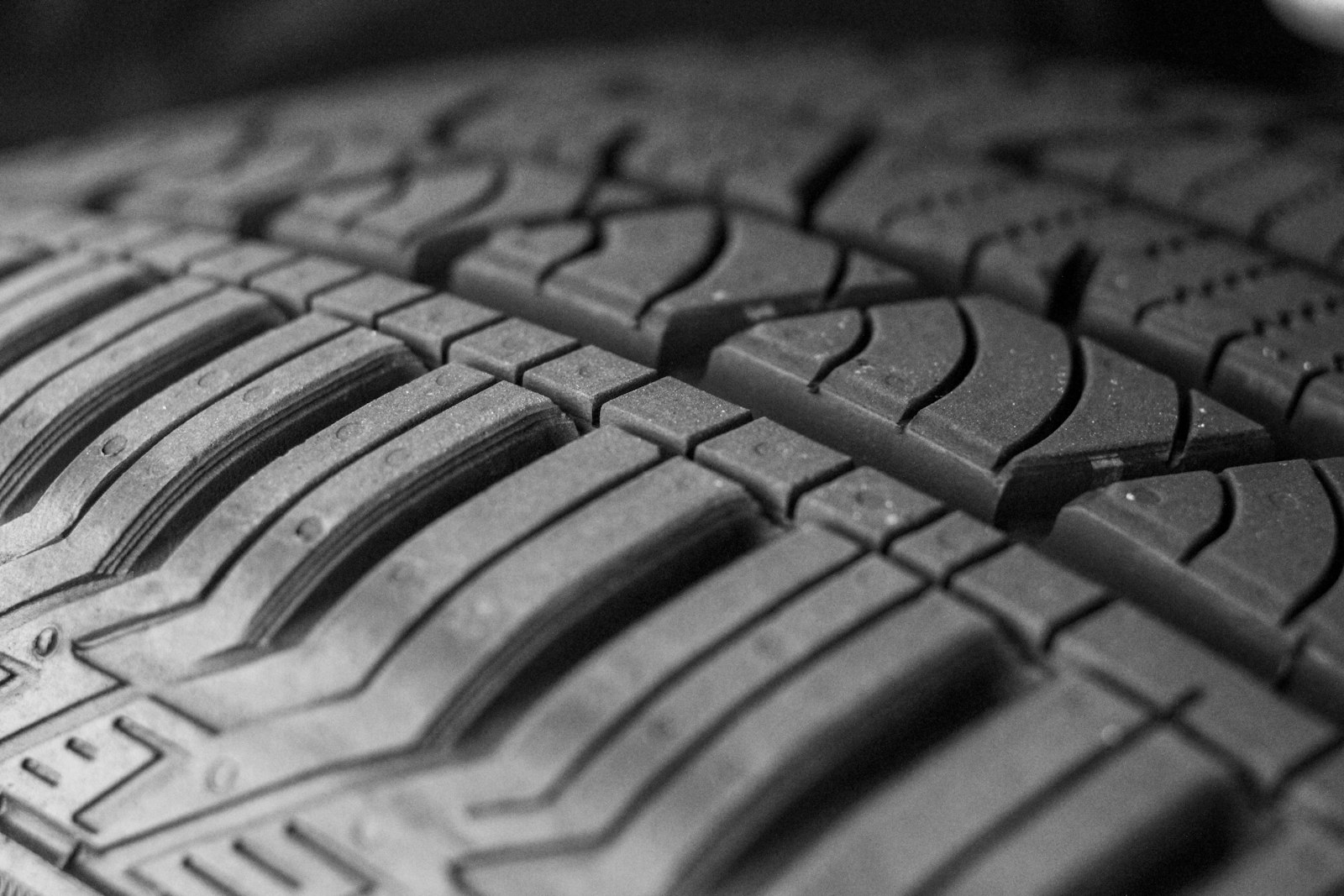
Tires have a dirty secret. They generate lateral cornering force not by gripping like a limpet, but through slip angle — the difference between the direction the tire is pointed and the direction it’s actually traveling. These are not always the same thing, which is already more honesty than most relationships manage.
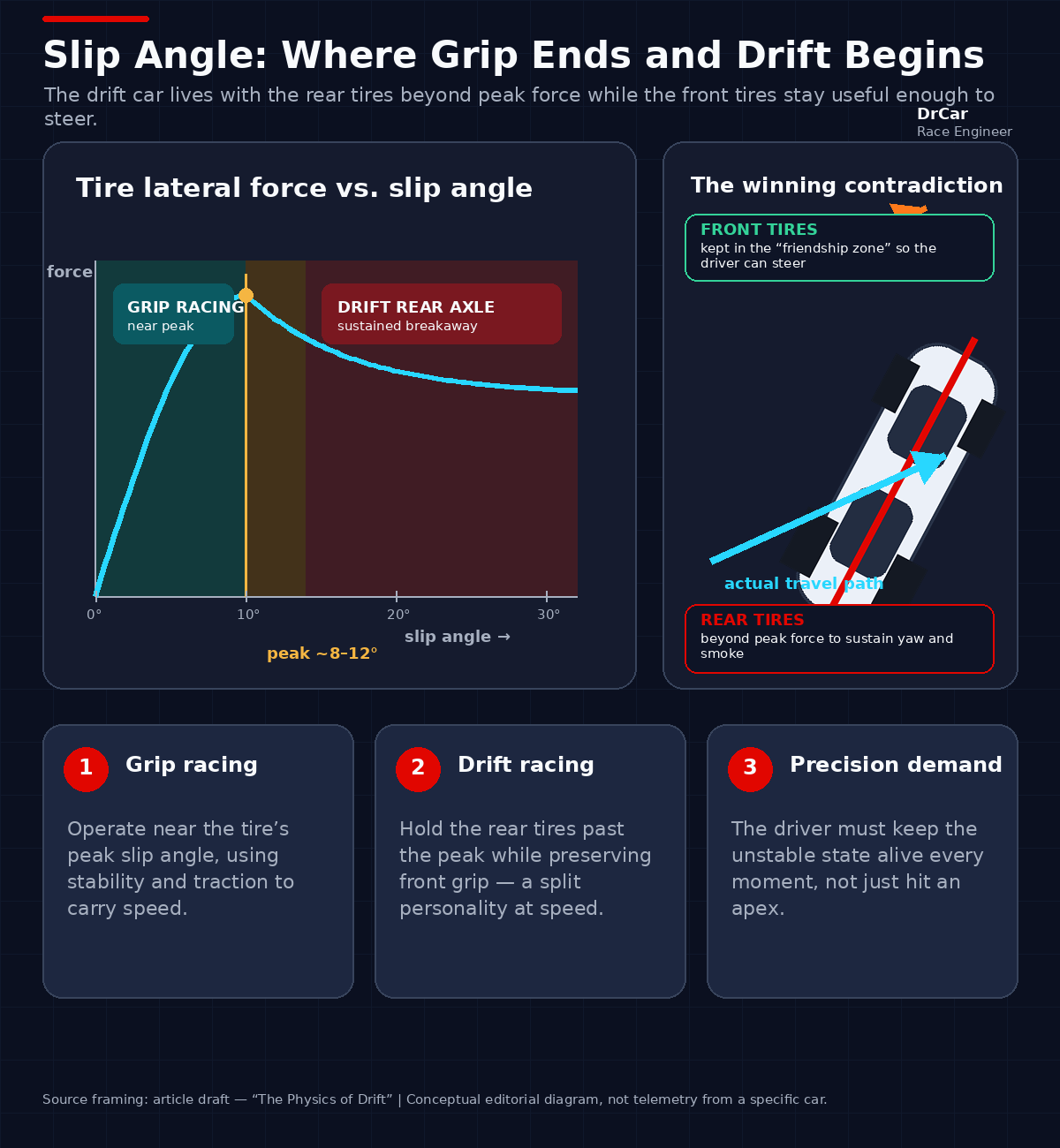
Up to a peak slip angle (typically 8–12 degrees depending on compound, temperature, and how much the tire is currently being asked to do), lateral force increases with slip angle. Past that peak, the tire enters what engineers call “breakaway condition” and what everyone else calls “oh no.”
In grip racing, the goal is to operate as close to peak slip angle as possible without exceeding it. Think of it as friendship with the tire — get close, enjoy the benefits, don’t push your luck.
In drifting, the rear tires are deliberately sent well past that peak. The rear contact patch is in a sustained breakaway. The tires are not your friends. The tires are more like colleagues you’ve given a very specific job they didn’t sign up for.
The front tires, critically, are kept in the friendship zone. They retain meaningful lateral grip, which is what allows the driver to actually steer and hold a line. This asymmetry — rear tires rebelling, front tires cooperating — is the technical core of drift. The car is simultaneously sliding and gripping in different axles, and the driver’s entire job is to keep it that way.
If you thought that sounded unstable: yes. That is the correct read of the situation.
The Three Inputs, and Why You Cannot Put Any of Them Down
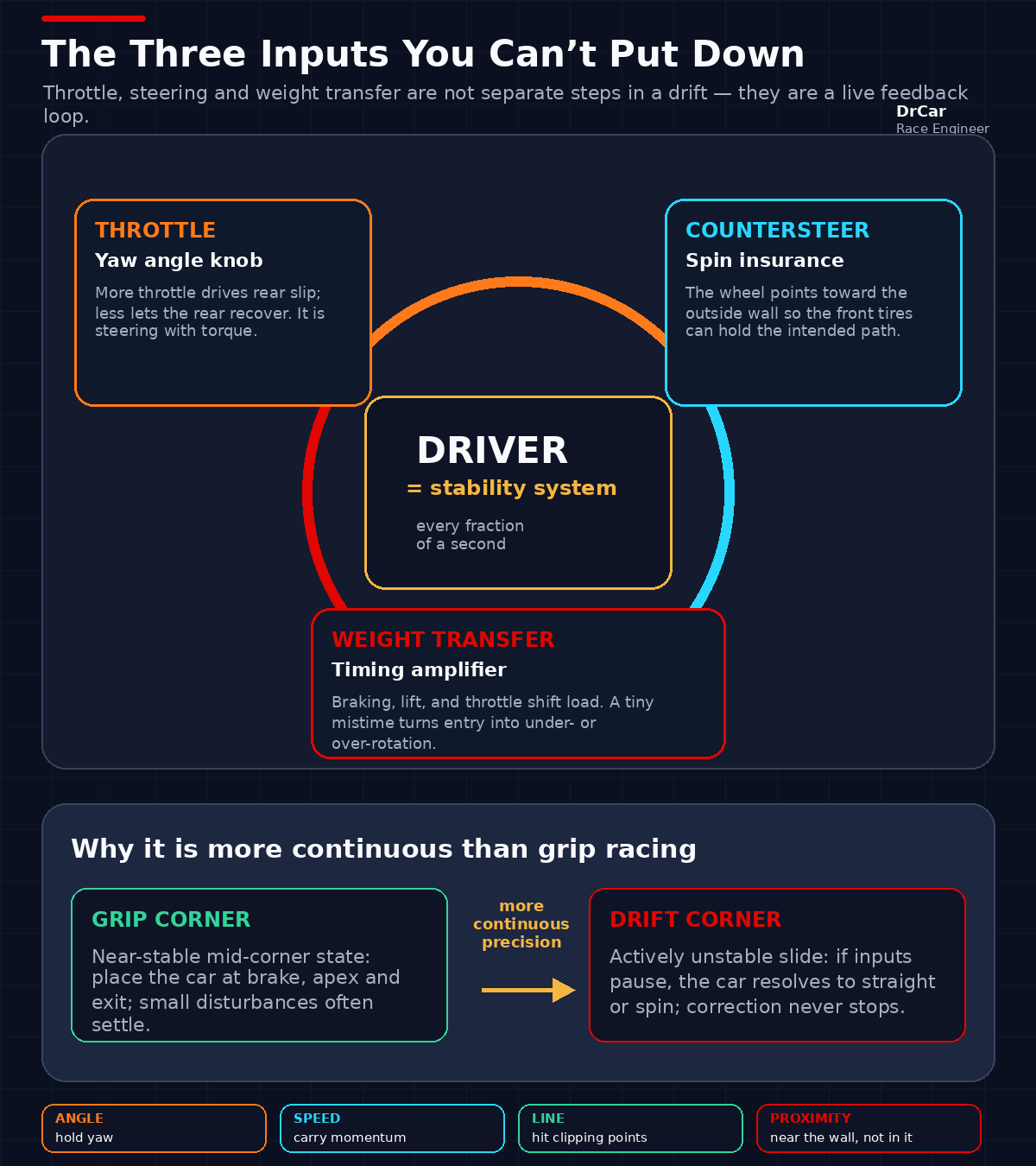
In grip racing, inputs have a certain civilized rhythm. Braking before the corner, steering through it, throttle on the way out. There are moments of relative calm. A driver in a well-balanced grip car at mid-corner is, in some meaningful sense, just going around a corner.
In a sustained drift, there is no such luxury. The car is in a continuous departure from equilibrium, and three inputs must be managed simultaneously, without pause, for the entire duration of the corner. Put one down for a split second and the car resolves — either by gripping up and going straight (embarrassing), or by spinning out (also embarrassing, but louder).
Throttle: The Volume Knob for Sideways
In rear-wheel-drive drift, throttle controls how far sideways the car is. More throttle increases drive torque at the rear wheels, increases slip, and pushes the rear further outboard — increasing yaw angle. Less throttle allows the rear tires to recover grip and reduces yaw angle.
The driver uses throttle not just to go faster, but to precisely dial in and hold the angle of the car relative to the corner. More sideways: add throttle. Less sideways: ease off. The correct amount of sideways: this is what the judges are paying to see.
This adjustment is continuous. Every change in road surface, speed, corner radius, and lateral load transfer shifts the yaw response to a given throttle input. The driver is solving a dynamic control problem in real time, not following a fixed plan. There is no “set it and forget it” here. You are the throttle map.
Steering: Steering Toward the Thing You Are Trying Not to Hit
At high yaw angles, the driver is steering toward the outside wall while the car rotates around them. The countersteer required can exceed 180 degrees of lock. From outside the car, this looks like the driver has given up. From inside the car, it is the only thing preventing a spin.
Too little countersteer: the car spins out. Too much: the car grips up and goes straight. The correct amount: somewhere in a narrow band that the driver has to track continuously as the car’s yaw state evolves through the corner. This is a job for someone with extremely good spatial awareness and extremely good timing, ideally under a few hundred horsepower of persistent encouragement.
The spatial demands are, to put it diplomatically, significant. Your vestibular system was not designed for this. The drift car driver’s was. Or it got very aggressively trained.
Weight Transfer: The Input You Don’t Control, But Have to Think About Anyway
Weight transfer is an output of the other inputs, not a direct control — but experienced drivers manage it deliberately anyway, because that is the level at which these people operate.
The entry sequence for a competition corner is a choreographed weight transfer procedure: trail braking shifts weight forward, unloading the rear and initiating rotation; throttle application at the right moment catches the rear at the desired yaw angle; countersteer is established before the rear fully loads up. Execute this correctly and the car enters the corner at the right angle, carrying the right speed, making exactly the right amount of tire smoke for the occasion.
Get the timing wrong by a fraction of a second and the car either underrotates (judge is unimpressed) or overrotates (everyone in the spectator area has a story to tell). The margin is genuinely small.
Competition drivers hit this sequence correctly, repeatedly, at speed. It is not an accident.
Why Drift Requires More Continuous Precision Than Grip Racing
Here is the claim, stated plainly, for those who like to argue about it on internet forums: drifting requires more continuous precision than grip racing, because it requires constant active stabilization of an inherently unstable state.
A grip car in a well-executed corner is in a near-stable state. Small perturbations self-correct through suspension geometry and tire behavior. The driver places the car correctly at the transitions — brake, apex, throttle — and the car largely behaves in between. It is a fundamentally civil arrangement.
A drift car in a well-executed slide is in an actively unstable state. Without continuous driver input, it resolves immediately — either to straight (boring) or to spin (see above). The driver is not managing transitions. The driver is the stability system. Every single moment of the corner requires active correction.
The analogy is the difference between flying a stable aircraft (which returns to level flight if you let go) and one with negative pitch stability (which immediately tries to kill you if you let go). The second type of aircraft is unpleasant to fly. Drift drivers do this on purpose, with a crowd watching, and then they get scored on whether they did it tidily enough.
Car Setup: Engineering the Instability to Be Manageable
Drift car setup reflects the goal, which is controlled instability rather than stability. The parameters have to be calibrated so that the car is difficult enough to spin that the driver has time to correct, but not so stable that it keeps wanting to grip up and go straight.
Rear suspension and geometry: Higher rear camber and modified toe reduce rear grip at the contact patch, making oversteer easier to initiate and sustain. A stiffer rear makes throttle-to-yaw response sharper and more predictable — which sounds alarming but is actually what you want when you’re using throttle as a yaw knob.
Differential: A locked differential is standard. A limited-slip diff has a selfcorrecting tendency — the outside wheel spinning faster generates a stabilizing effect — which sounds like a good idea until you realize it fights the sustained slide. Locked means equal torque to both rear wheels, which gives the driver cleaner, more linear control. No self-correction. The driver is the correction.
Power: High output, broad torque curve. More torque per degree of throttle travel means finer yaw control resolution. Very peaky power delivery makes this harder — the difference between “just enough to hold the angle” and “spinning violently” gets too small to manage reliably. Broad torque is more forgiving. Only slightly more forgiving.
Front grip: This one surprises people. Front tires are maintained at normal grip specification or close to it. The front end is the anchor that makes the rear slide controllable. Reduce front grip and the driver loses the steering authority to hold their line — the entire system falls apart. You need the front to grip so that the back can slide. The front tires are, in fact, the responsible adults in this situation.
The Scoring: Because “Still Alive” Is Not Enough
Formula Drift and comparable competition series score on angle, speed, line adherence, and proximity to clipping points. The implication is that surviving the physics is not the performance — it is merely the prerequisite. The performance is executing a specific spatial path at a specific yaw angle at a specific speed while judges watch and award points for elegance.
This is the full demand of competition drift: not just managing an unstable system, but expressing it within a judged aesthetic envelope, at competition velocity, in front of a crowd that paid to see either excellence or disaster and is genuinely happy with either.
Controlled chaos is the wrong frame. Precisely managed instability, aggressively styled, with generous smoke output, is more accurate. The chaos isn’t let in.
It’s invited. Carefully. With a locked diff and a prayer for the front tires.
Download our “Drift Physics Workbook” with exercises to understand and practice controlled slide dynamics.