

Target keyword: sim racing to real racing skills
You’ve spent two thousand hours on iRacing. You know Watkins Glen’s chicane by the apex of the apex. You’ve chased tenths on Spa, dissected your brake traces at Bathurst, and talked setup with engineers who’ve never actually left their office chairs. The corner doesn’t look hard anymore — it looks familiar.
Then you strap into a real car for the first time at an HPDE event, roll out of pit lane, and the track feels like it was built by someone who read about corners but never drove one.
That gap — between screen and seat — is the most useful thing sim racing can teach you. But only if you understand it before you arrive.
What the Sim Gets Right
Lines, Braking Zones, and Visual References
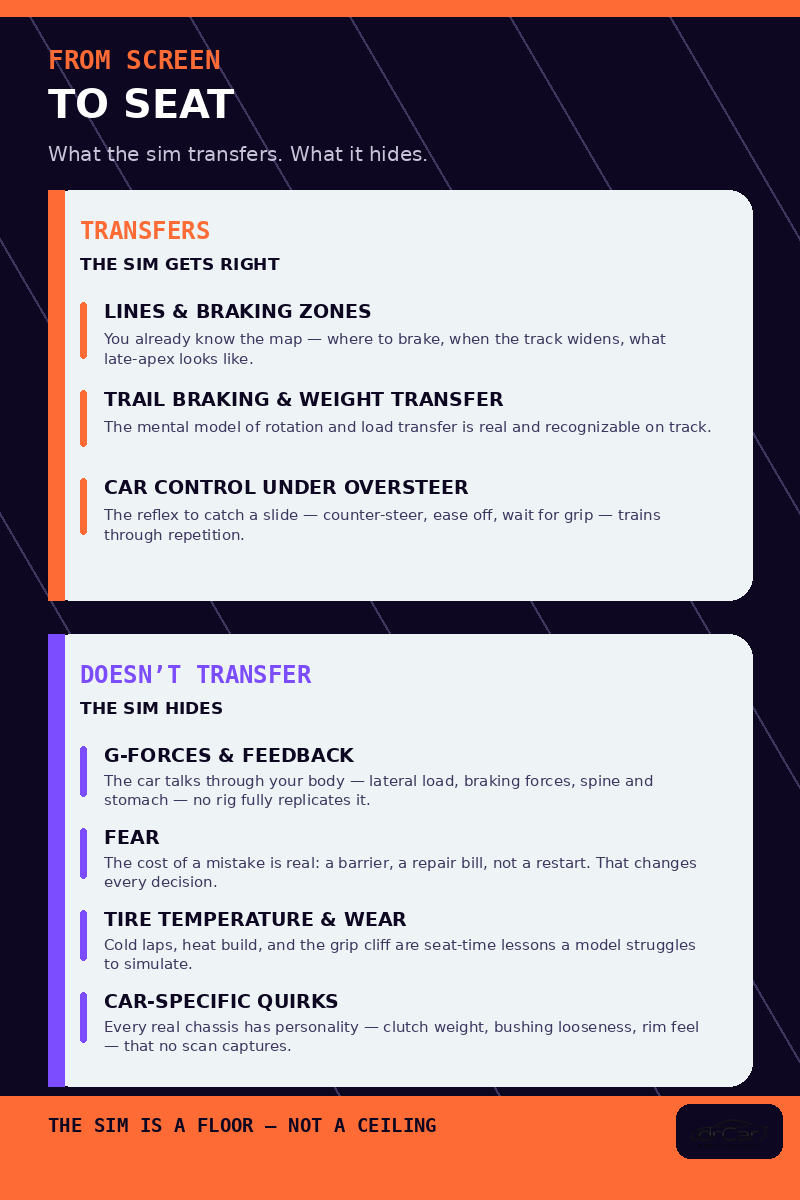
The geometry of a corner doesn’t change. If iRacing has modeled a circuit you’re attending, you already know where the 200-meter board hangs, where the track widens at exit, and what late-apex actually looks like from the driver’s perspective. That visual library transfers directly.
First-time track drivers often spend an entire morning simply figuring out where to brake. Sim racers skip that tuition entirely. They arrive knowing the map. The rest of the session can be spent learning the territory.
Trail Braking and Weight Transfer Mechanics
Modern sims — particularly iRacing and Assetto Corsa Competizione — model tire physics with enough fidelity that the principle of trail braking, cadence braking on ABS-equipped cars, and progressive throttle application on exit are all teachable. Drivers who’ve felt their sim car rotate under trail braking will recognize the sensation when the real nose begins to turn.
This is a genuine head start. Instructors spend entire track days explaining weight transfer to drivers who’ve never felt it. You already have the mental model.
Car Control Under Oversteer
The reflex for catching a slide — counter-steer, ease the throttle, wait for grip — is a motor skill. Sims reinforce that reflex through repetition. Real tire slip happens faster and with more consequence, but the hands-and-feet logic is the same. Drivers who’ve saved hundreds of iRacing spins are better positioned to save the real thing than drivers who have never felt a car step out at all.
What the Sim Hides
G-Forces and Physical Feedback
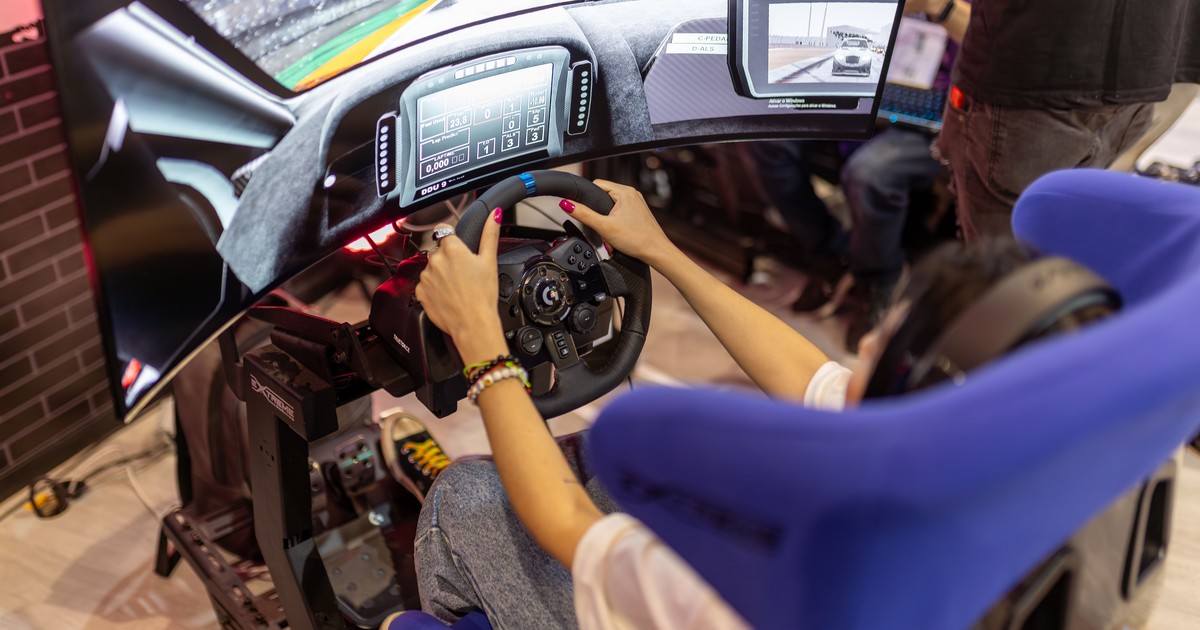
A sim delivers information through your eyes. A real car delivers it through your entire body. Lateral g-forces compress you into the seat bolster through a fast sweeper. Braking loads push you hard into the harness. The car communicates through your spine, your stomach, and your hands in ways no force-feedback wheel or motion rig has fully replicated.
The first time you carry real speed into a real corner, the sensation is genuinely alarming — and that alarm slows you down. This is appropriate. Respect it. The sim told you the corner is theoretically flat. Your body will remind you that it’s running real tires on real asphalt.
Fear
Fear has no in-game equivalent. In a sim, the consequence of a mistake is a restart. On track, it’s a barrier, a repair bill, or worse. That emotional weight changes how you process speed and changes the decisions you make at the limit.
This isn’t a flaw of sim racing — it’s just reality. Expect your real-world pace to be noticeably slower than your sim pace at first. That’s not failure. That’s self-preservation operating correctly.
Tire Temperature and Real-World Degradation
Sims model tire compounds well, but they struggle to simulate the full arc of a tire’s working range — the cold lap, the heat build, the cliff when temperature or load exceeds the window. Real track driving teaches you what cold tires feel like in the first sector before they’ve come up to temperature. It teaches you when to push and when to manage. That nuance takes seat time to develop.
Car-Specific Quirks
Every physical car has personality that no scan can fully capture. The way a particular chassis telegraphs understeer through the rim. The specific heaviness of a clutch pedal. The moment an older suspension bushing lets a corner feel loose in a way a fresh sim model never would. These are learned with laps, not with hours online.
How to Close the Gap
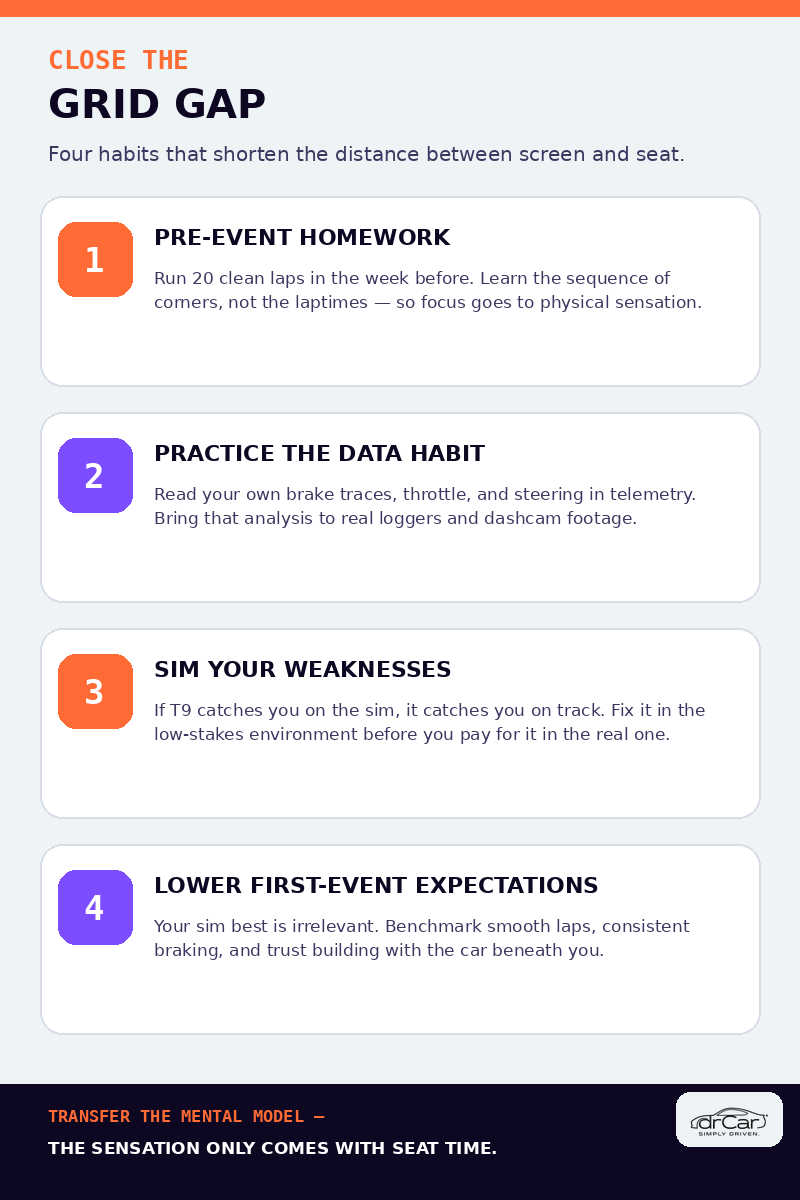
Use the sim for pre-event homework. If the circuit is on your sim platform, run twenty clean laps in the week before the event. Focus on the sequence of corners, not the laptimes — the same kind of virtual preparation engineers use to test a hypercar before it reaches the track. You want the layout automatic so your focus at the event can go toward physical sensation.
Practice the data habit online. Tools like iRacing’s telemetry overlay or MoTeC-compatible exports teach you to read your own brake traces, throttle application, and steering inputs. Bring that same analytical habit to real track sessions, where dashcam footage and data loggers tell the same story with real consequences.
Sim your weaknesses. If T9 always catches you on the sim, it will catch you on track too. The error compounds when grip and fear are real. Address it in the low-stakes environment before you pay for it in the high-stakes one.
Lower your expectations for the first event. Your sim best time is irrelevant on a real track day. The benchmark is smooth laps, consistent braking, and building trust with the car beneath you.
The Verdict
Sim racing is one of the most efficient tools available for learning circuit fundamentals before you ever pay a track entry fee. Lines, braking points, and car control instincts all transfer. The thing that doesn’t transfer — and that no training can fully replicate — is the sensory and emotional reality of driving fast on real asphalt.
That gap is exactly why real track time matters. A well-prepared sim racer will learn faster, waste fewer laps on orientation, and be better positioned to listen to an instructor. But the sim is a floor, not a ceiling. The ceiling lives at the track.
Before your first event, it’s also worth confirming your coverage — most personal auto policies exclude on-track use, and a dedicated track-day policy protects both your car and your daily driver without surprises.
Now take what you’ve built on screen and go find out what the corner actually feels like. If you’re not sure how to get on a real circuit yet, volunteering trackside is a low-cost way in.
How much did sim time help your first real track day? Share your verdict on DrCar.