

You switched to an EV to save on fuel. Then you noticed the tires wearing faster than they ever did on your old combustion car. Welcome to one of the least-talked-about costs of electric ownership — and one of the most fixable.
EV tire wear explained comes down to three compounding factors: weight, torque, and braking style. Once you understand each one, the solution becomes obvious.
The Weight Problem
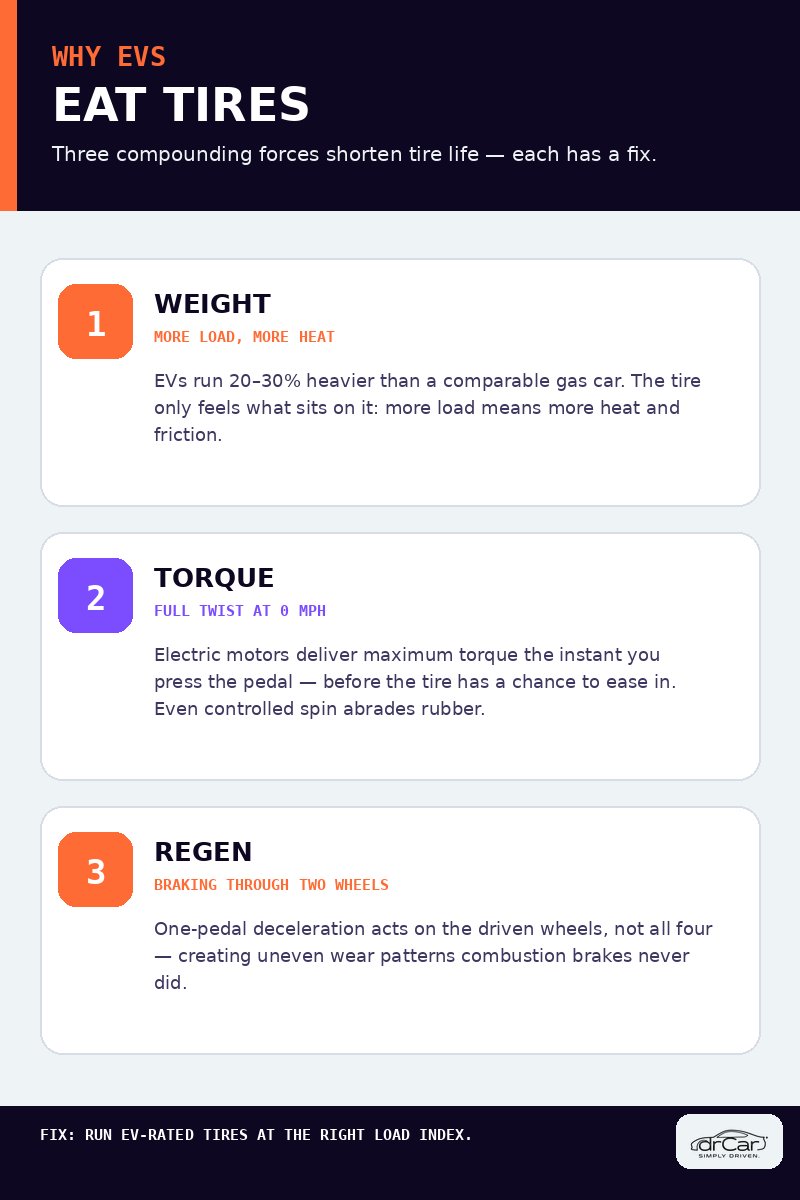
An average mid-size EV weighs 20 to 30 percent more than a comparable gas car. A Tesla Model 3 Long Range tips the scale near 4,300 lb. A Toyota Camry sits around 3,300 lb. That extra thousand-plus pounds presses down on four contact patches the size of a human hand.
Tires wear in proportion to the load they carry. More weight, more heat, more friction. It’s designed for how you actually move — the tire doesn’t care what’s powering the car; it only feels what’s sitting on top of it.
Manufacturers compensate by speccing tires with higher load ratings. If you’re replacing a set, the load index stamped on your sidewall is not optional — it’s engineered for the vehicle’s curb weight.
The Torque Problem
Electric motors don’t build power through a rev range. They deliver maximum torque the instant you press the pedal. In a performance EV, that means full twist at 0 mph — before the tire has any chance to ease into acceleration.
On a dry road, most of that torque translates into acceleration. On a damp surface or a corner exit with a heavy throttle input, it translates into spin. Even controlled spin — the kind you don’t feel or hear — abrades rubber faster than steady highway cruising.
Aggressive launches, even casual ones, compound over thousands of miles. If you’re in the habit of leaving stoplights with authority, your front or rear tires (depending on drive layout) are absorbing the difference.
The practical solution isn’t to drive like you’re hauling glass. It’s to use the drive mode options your car gives you. Comfort or standard mode limits torque delivery at low speeds. Sport mode is for when you want it — not every merge onto the freeway.
The Regenerative Braking Problem
Regen is one of the great practical advantages of electric driving — lift the throttle and the motor slows the car, recapturing energy and reducing brake pad wear. But regen applies deceleration force through the driven wheels, not all four. That imbalance creates uneven wear patterns that conventional brake-bias calculations weren’t designed around.
One-pedal driving at maximum regen adds up. The tires doing the braking work wear differently than the ones along for the ride. The solution, again, is rotation — and rotation done more frequently than the combustion-car schedule you’re used to.
EV-Specific Tires: Why They Exist
Tire manufacturers now build compounds explicitly rated for electric vehicles. These differ from standard tires in three meaningful ways:
Load rating: Higher structural ratings to handle battery weight without heat buildup.
Rolling resistance: Lower-resistance compounds reduce energy loss, extending range. A standard tire can cost a real-world range penalty of 5 to 10 percent. That’s not marketing — it’s physics. A tire with higher rolling resistance forces the motor to work harder every mile.
Noise reduction: EVs are quiet. Road noise that a combustion engine buried becomes plainly audible in an EV cabin. EV-rated tires use foam inserts or optimized tread patterns to address this.
If your car shipped with a tire displaying an EV, EV-E, or similar badge, that’s the compound the engineers validated. Substituting a non-rated tire to save money often costs more in range and replacement frequency.
Inflation: The Cheapest Fix
Underinflation increases the contact patch — more rubber touching road means more wear. It also increases heat, the fastest way to shorten a tire’s life. Every 10 PSI below spec raises rolling resistance meaningfully and accelerates shoulder wear.
EVs put the recommended pressure in the door jamb, same as any vehicle. Check it monthly — not quarterly, not when the TPMS light triggers. The TPMS warning fires at around 25 percent below spec, which is already deep into wear territory.
Note: Cold weather drops tire pressure roughly 1 PSI for every 10°F temperature fall. If you’re in a climate with real winters, winter mornings deserve a quick check.
Rotation Schedule: Reset Your Clock
The standard rotation interval — often cited at 7,500 to 10,000 miles — was written for combustion vehicles with balanced mechanical braking. EV tire wear is more uneven by design.
Most EV manufacturers specify rotation at 6,000 to 7,500 miles. Some recommend every 5,000 miles for high-regen drivers. Check your owner’s manual. If it doesn’t specify, default to 6,000 miles and adjust based on what you observe.
Consistent rotation catches the uneven patterns early, before one axle’s tires reach the wear indicators while the other set still has plenty of life. Skipped rotations are expensive — you end up replacing two tires at a time instead of four.
EV Tire Wear by the Numbers
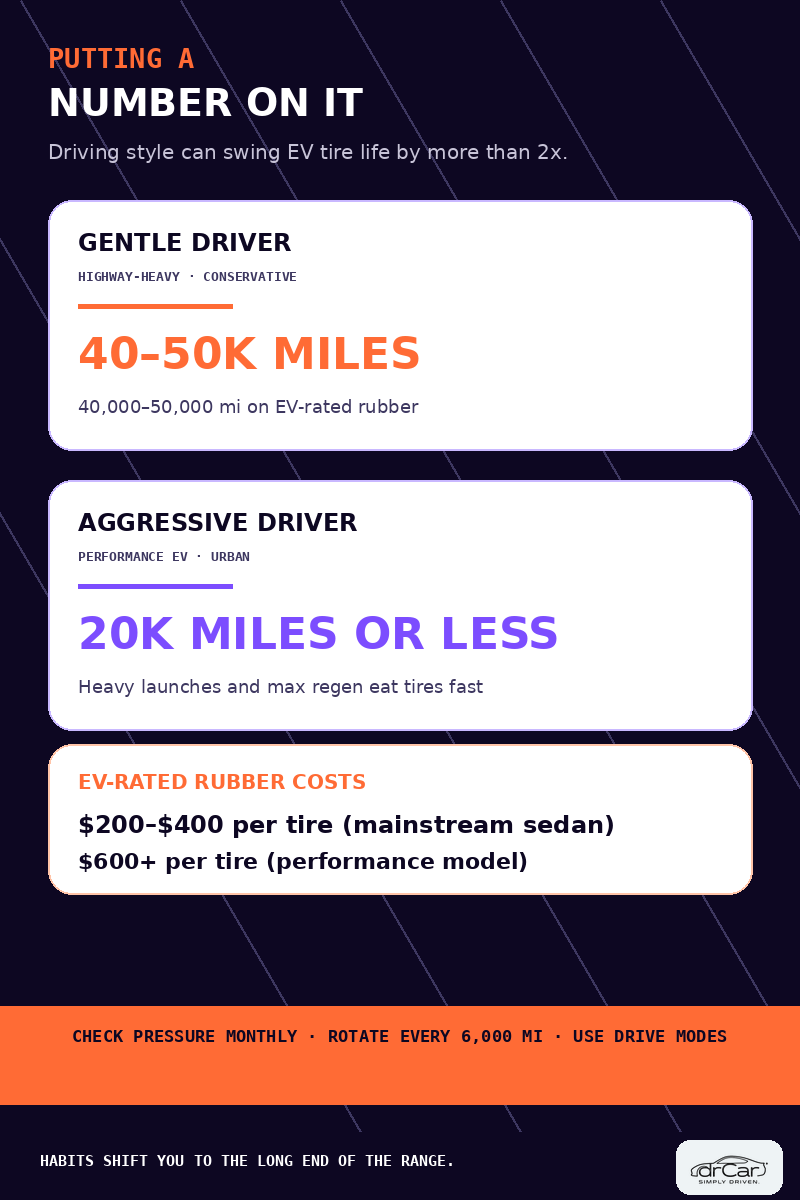
Real-world EV tire life varies widely: conservative drivers on highway-heavy routes report 40,000 to 50,000 miles; aggressive urban drivers on performance EVs report 20,000 miles or less. The factors under your control — inflation, rotation, drive mode selection — can shift you toward the longer end of that range.
At $200–$400 per tire for EV-rated rubber on a mainstream sedan, and up to $600+ on a performance model, the math on preventive habits is clear. Keeping good insurance on a higher-value vehicle is the same logic applied to tires: protecting what you’ve invested in costs less than replacing what you lost.
The Short Version
EVs are harder on tires than gas cars. Weight, instant torque, and regen braking create wear conditions that older tire habits don’t fully address. The solution isn’t complicated: run EV-rated tires at the correct load index, check inflation monthly, rotate at 6,000-mile intervals, and use drive modes to manage torque delivery.
The tire life you recover pays for the habits quickly.
What is the real tire life on your EV? Drop your mileage and tire combo on DrCar.