


Mobility is being redesigned in real time — and this time, it’s happening above the rooftops.
For most of the twentieth century, flying cars existed in two places: science fiction and the graveyard of ambitious engineering projects. The concept kept colliding with physics, economics, and the basic inconvenience of needing a runway. The dream persisted. The reality didn’t.
That gap is closing, faster than almost anyone outside the industry anticipated.
Electric Vertical Take-Off and Landing vehicles — eVTOLs — have moved from aerospace curiosity to capital-intensive commercial development in under a decade. More than a hundred companies worldwide are now building or certifying them. Several have already carried passengers. Regulatory frameworks are being written, vertiport infrastructure is being funded, and the question is no longer whether urban air mobility will exist — it’s when it becomes part of how cities actually move.
The answer, increasingly, is: sooner than the city is ready for it.
What eVTOL Actually Is — and Why It’s Different
The “flying car” framing is evocative but slightly misleading. Most eVTOL vehicles are not cars that fly — they are electric aircraft designed specifically for short urban trips, optimized for vertical takeoff and landing without the infrastructure of traditional aviation.
The architecture varies by design. Some resemble multirotor drones scaled to carry one to six passengers, with distributed electric motors on multiple rotor arms. Others take a more conventional tilt-rotor or fixed-wing-plus-lift approach, gaining efficiency at cruise altitude while retaining vertical capability for takeoff and landing. A third category — electric helicopter derivatives — bridges the gap between existing rotorcraft and fully novel design.
What unifies them is electrification. The shift from combustion to electric propulsion is the enabling technology that makes urban air mobility plausible in a way it wasn’t before. Electric motors are lighter, simpler, and more reliable than combustion engines at small scales. They produce less noise — a critical factor for urban operation. They allow distributed propulsion: multiple smaller rotors rather than a single large one, which improves redundancy and safety margins. And they eliminate the local emissions that would make dense urban aerial operations politically untenable.
Battery energy density remains the binding constraint. Current lithium chemistry limits practical eVTOL range to roughly 50-100 kilometers per charge depending on payload and configuration — enough for intracity and near-suburban routes, not enough for regional air travel. But battery technology is improving, and the initial use cases don’t require regional range.
The Realistic Timeline
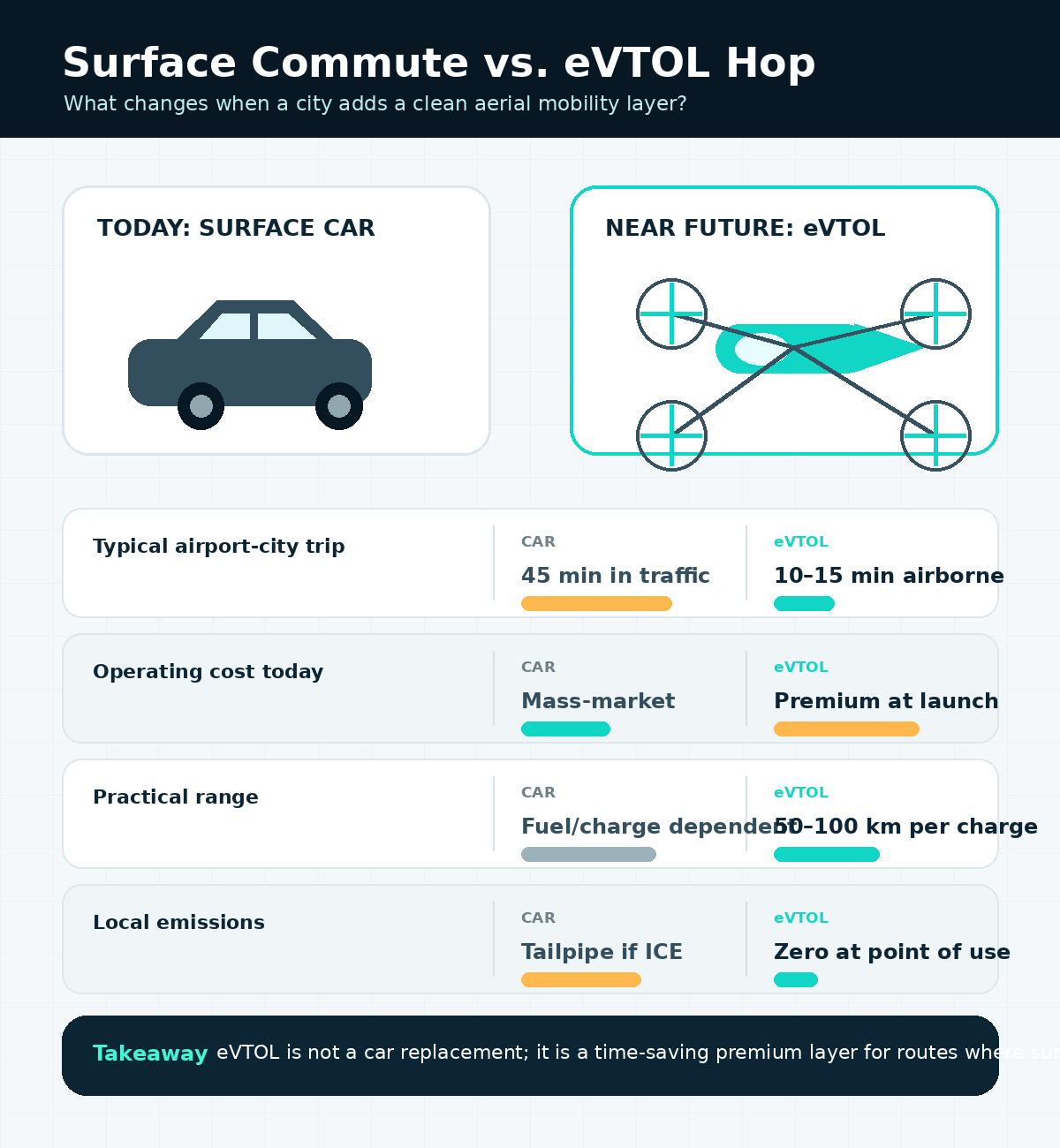
A practical comparison of what eVTOLs improve first — time — and what remains constrained at launch.
The first commercial eVTOL passenger services are not concepts or projections — they are permitted, partially operational, or in final certification. The timeline looks something like this:
2024-2026 — First commercial routes: Joby Aviation, Archer, Wisk, and several European competitors received type certification progress or began limited commercial operations in this window. Joby completed piloted passenger demonstrations and signed partnership agreements with airlines. Archer’s Midnight completed test flights at full passenger weight. The Dubai and Singapore aviation authorities moved aggressively to position their cities as early vertiport hubs.
2026-2028 — Regulated commercial expansion: The FAA’s Special Federal Aviation Regulation framework for powered-lift aircraft established the regulatory pathway for commercial operations. European Union Aviation Safety Agency (EASA) certification of the Lilium Jet-successor aircraft and Volocopter’s VoloCity opened Western European markets. Initial services connect airports to city centers — the highest-demand, lowest-complexity route structure.
2028-2032 — Infrastructure buildout: Vertiport networks expand beyond single-node airport connections. Urban vertiports — purpose-built rooftop and ground-level facilities with fast-charging capability — begin appearing on major transit hubs, hospitals, and commercial centers. The mobility ecosystem model emerges: eVTOL as a premium layer within existing multimodal networks, connected to ground transit through unified booking systems.
Post-2032 — Autonomy transition: Piloted operations give way progressively to reduced-crew and eventually fully autonomous operations as the safety record accumulates. This is the inflection point at which cost structures change materially — removing the pilot cost approximately halves operating expenses, which is the threshold at which broad consumer accessibility becomes viable.
What It Means for Cities
Urban air mobility doesn’t just add a transportation mode — it restructures the economic geography of cities in ways that will take decades to fully register.
Time geography changes. A 45-minute surface commute becomes a 10-minute aerial one. At scale this doesn’t merely save time — it redefines which locations are practically accessible from which others. Neighborhoods currently penalized by poor surface transit access gain effective proximity to employment and amenity centers. This is potentially the most significant urban planning implication: air mobility could dissolve some of the transit deserts that have shaped urban inequality for generations.
Airport adjacency shifts. The current premium on real estate within easy driving distance of major airports erodes when a vertiport network distributes that access across a metro area. The airport hotel cluster gives way to the distributed urban vertiport district.
Emergency and critical services transform. Medical evacuation, organ transport, disaster response, and infrastructure inspection already show the highest near-term ROI for aerial mobility in urban environments. These applications build the operational infrastructure — vertiports, air traffic management systems, pilot training pipelines — on which commercial passenger services depend.
Noise and airspace equity become political battlegrounds. Aerial corridors over urban neighborhoods carry noise, privacy, and safety implications that will generate significant public debate. The industry’s claim that eVTOL noise profiles are materially better than helicopters is largely substantiated — but “better than a helicopter” is a low bar in residential contexts. Urban air mobility will require genuinely inclusive planning processes to avoid replicating the infrastructure inequities of the highway era.
The Missing Piece: Ground-Level Integration
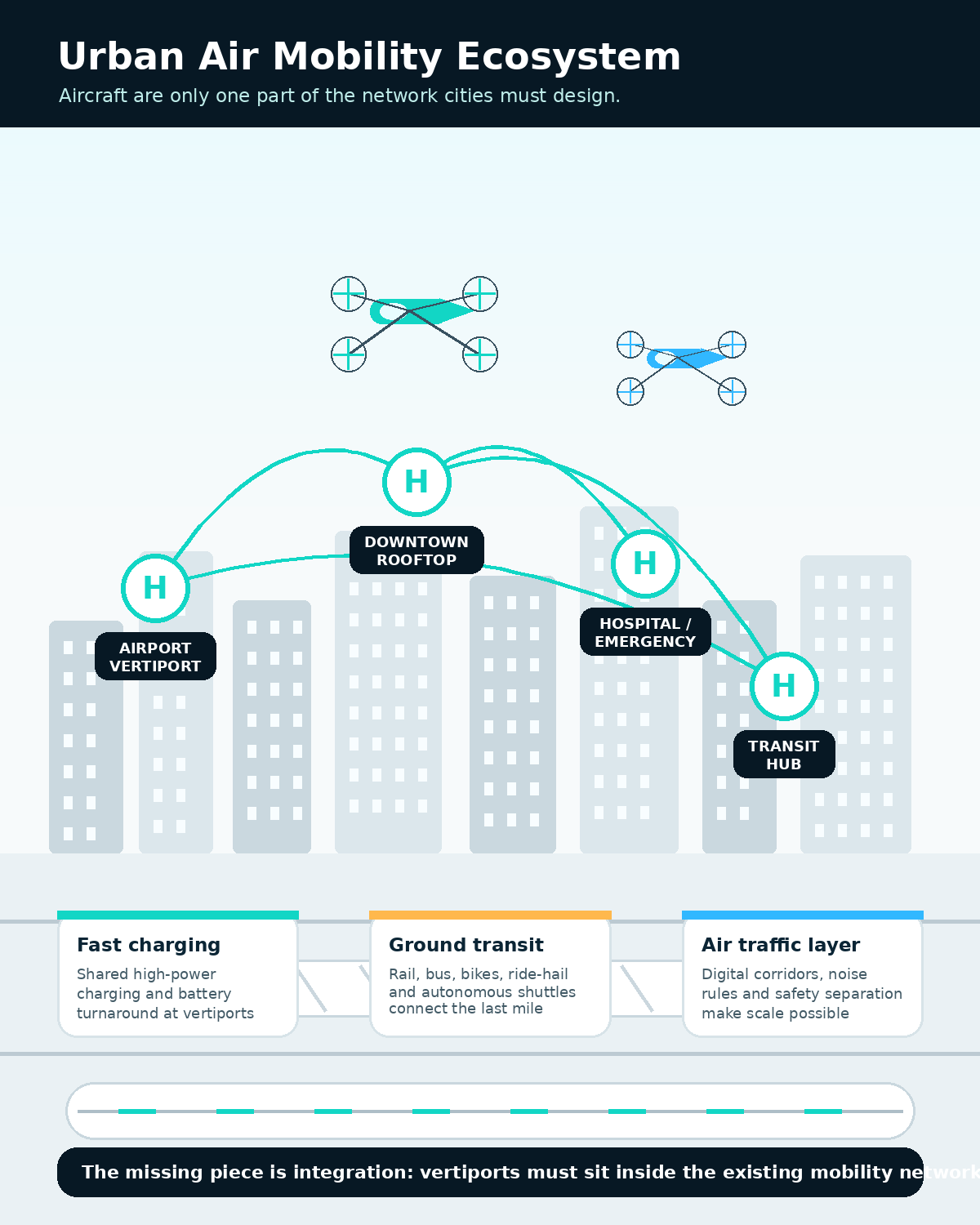
Urban air mobility only works when aircraft, vertiports, charging, air corridors, and ground transit are designed as one system.
The most underappreciated challenge in urban air mobility is not the aircraft. It’s the first and last mile.
A vertiport serves no one effectively if reaching it requires fighting the same surface congestion that aerial mobility is designed to bypass. The value proposition collapses unless vertiports are integrated into existing transit infrastructure — placed at rail stations, bus terminals, mobility hubs — or served by seamless autonomous ground connections.
Cities that get this right will look fundamentally different within a generation. Not because the sky fills with aircraft — the densities required for that are decades away — but because the mobility ecosystem becomes genuinely multimodal at a granularity that surface infrastructure alone cannot achieve.
The transformation is not flying cars. It’s cities that work better because moving through them, at every level including the one above the rooftops, becomes genuinely accessible.
Mobility is being redesigned in real time. The question is whether cities are designing along with it — or discovering the implications after the fact.
Access our interactive “Urban Air Mobility Map” showing planned vertiport locations and service timelines.