

Before a single tire ever touches the Circuit de la Sarthe, Ford Hypercar 2027 engine testing has already validated the race program in Dearborn, Michigan. Engineers have run the entire 24-hour course long before the physical car ever reaches the track.
Not metaphorically. Not in a static driving simulator with a padded seat. On a high-response transient engine dyno, the 5.4-liter V8 destined for Ford’s 2027 FIA World Endurance Championship Hypercar entry has completed full laps of Le Mans — every gear change, every full-throttle blast down the Mulsanne straight, every heavy brake-dive into the Ford Chicanes, every partial-load corner exit — reproduced in real time on instrumented hardware.
This is how modern championship campaigns are won before testing begins.
Ford Hypercar 2027 Engine Testing: What Transient Dyno Runs Mean
A traditional steady-state dyno run tells you peak power and torque. It reveals what an engine can do at wide-open throttle with stabilized oil and coolant temperatures, but it tells you almost nothing about what happens at lap 21 of 24 when throttle inputs vary every two seconds, underbody heat soaks the chassis, and the driver pushes 9,000-plus rpm through a kink that never fully loads the tires. Much like understanding race-car physics and vehicle dynamics under extreme loads, transient testing isolates the real-world stresses that steady-state runs miss.
Transient dyno testing is the difference between a static photograph and a full-motion film.
Ford’s engineers feed the dyno a complete circuit duty cycle — a mathematically precise profile of throttle position, engine speed, torque load, and rpm transitions that mirrors what the Le Mans course physically demands. The dyno’s servo system responds faster than any human driver could, replicating the exact torque requests and load reversals that occur across an 8-minute-plus lap. The engine doesn’t know it isn’t at the Sarthe. Its combustion chambers, valve train, and cooling circuits respond exactly as they would at full race pace.
That real-world fidelity is the entire point.
The Le Mans Duty Cycle: Why This Track Is Different
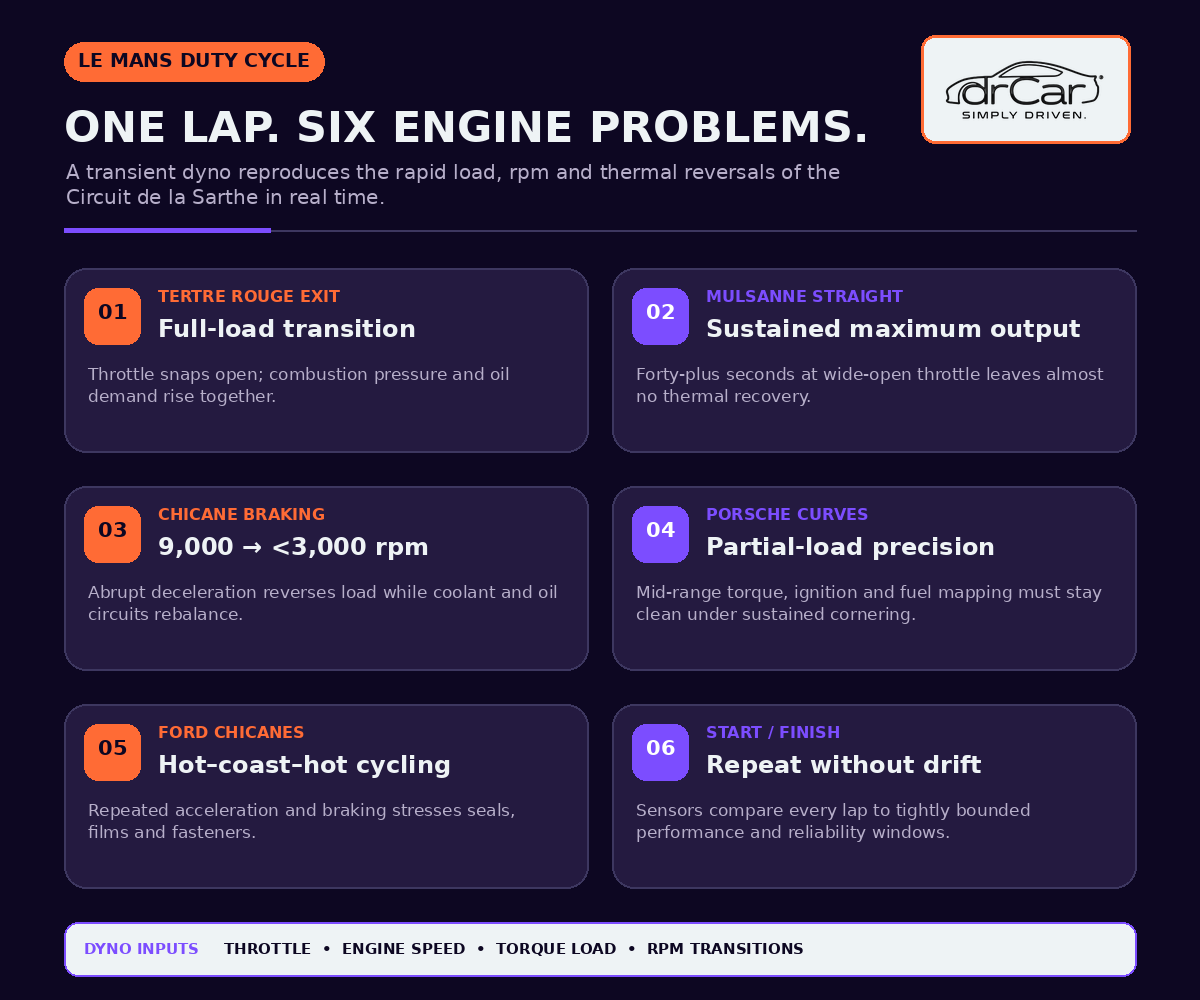
Le Mans is not a single challenge. It is six distinct engineering problems stacked into one circuit.
The Mulsanne straight once allowed terminal velocities above 400 km/h. Even with two chicanes inserted for safety, sustained wide-open-throttle intervals still exceed forty seconds. For a naturally aspirated Hypercar V8, that means continuous maximum-output combustion events with zero thermal recovery. Pistons, rings, and cylinder heads absorb heat that has nowhere to go quickly.
Then the driver brakes hard. Engine braking drops revs from 9,000 to under 3,000 in seconds. Coolant that couldn’t transfer heat fast enough under maximum load now sees a sudden change in flow demand. Oil circuits working at peak pressure must rebalance instantly. This thermal cycle — intense heat followed by sudden coasting — is far more destructive than steady-state high-speed running.
Add the Porsche Curves, a flowing complex that requires partial throttle and sustained mid-range torque for nearly a minute. The engine spends long periods in a combustion regime that is neither fully loaded nor fully unloaded — a zone where fuel mapping, ignition timing, and exhaust scavenging must all perform cleanly to prevent deposits, misfires, and oil film degradation on cylinder walls.
The transient dyno replays all of it, lap after lap after lap.
Reliability Validation: Proving 24 Hours Before the Clock Starts
Ford’s top-class WEC return represents the brand’s most consequential motorsport commitment since the 1960s. The pressure to perform — and finish — is absolute. At Le Mans, an engine failure does not just cost a podium; it costs the entire race and months of momentum.
Endurance-racing engine development is therefore not primarily about peak horsepower. It is about total failure-mode elimination.
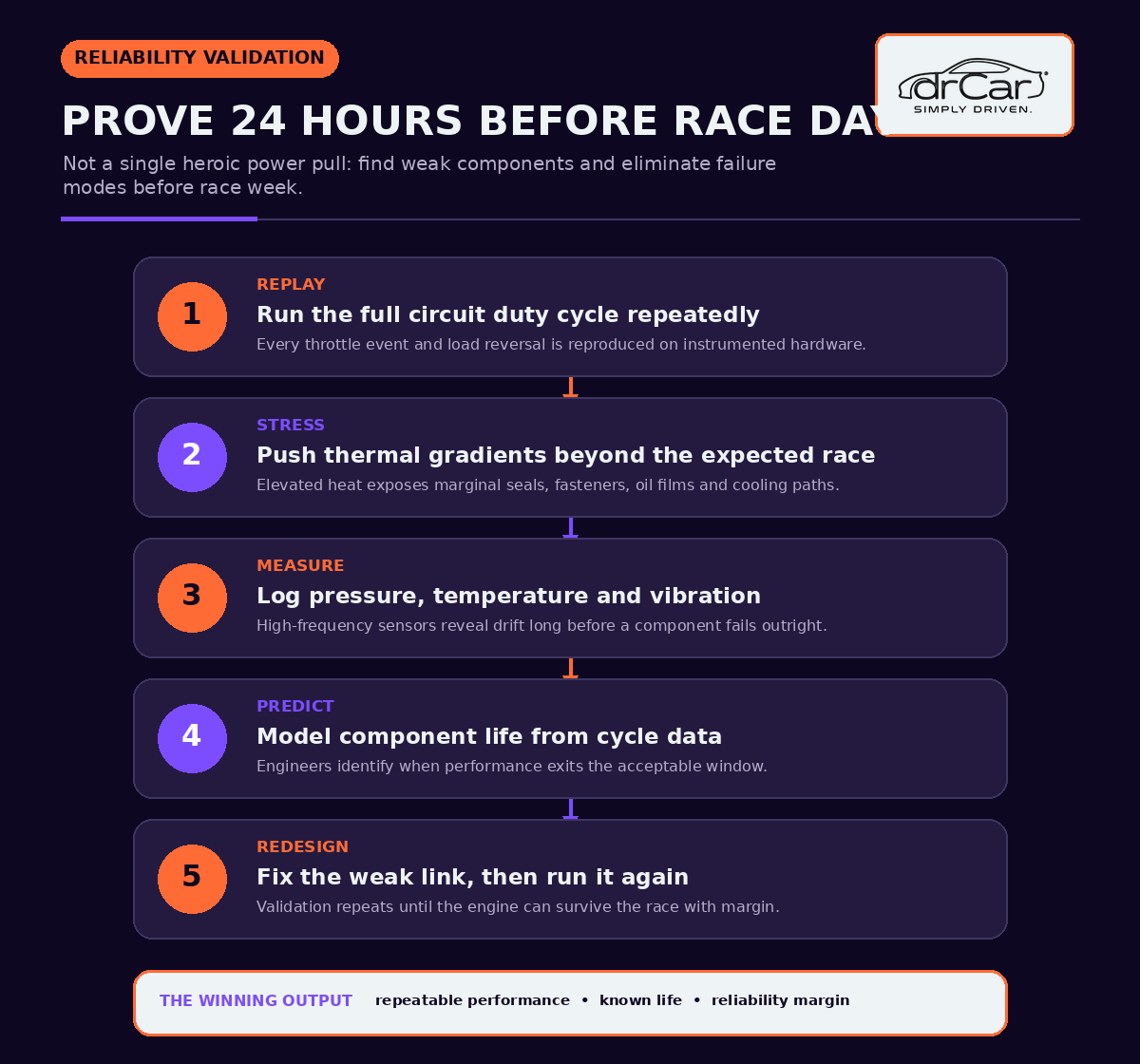
Engineers run extended dyno programs at elevated thermal loads to expose heat-related failure points before they surface at circuit speed. They induce thermal gradients steeper than the race itself will produce, identifying component weaknesses under combined mechanical and thermal stress. High-frequency oil pressure sensors, coolant thermocouples, and vibration accelerometers log every cycle, building a dataset that lets engineers predict component life with actuarial precision.
When a head bolt torque retention pattern drifts at hour 14 on the dyno, engineers resolve it in Dearborn — not in the pit lane after a retirement.
The 5.4-liter V8 must demonstrate the capacity to run the Le Mans duty cycle repeatedly and reliably before it earns the right to be installed in a race chassis.
Cockpit Integration: Removing the Human Unknown
Dyno testing validates the engine in isolation, but isolation is not race reality.
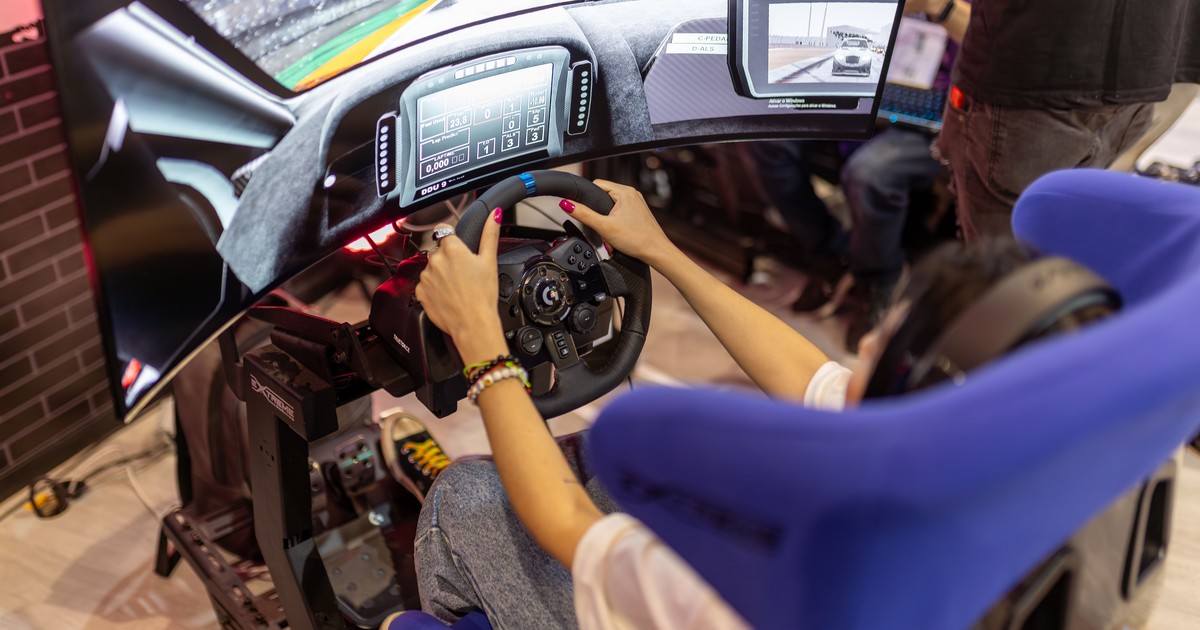
Ford’s engineering program incorporates physical driver cockpit mock-ups built around the Hypercar chassis architecture. These rigs allow drivers and system engineers to refine the human-machine interface before track testing begins. Paddle-shift calibration, brake-bias adjustment ergonomics, and steering-wheel display layouts are iterated in a static rig long before operating at 200 mph under 3.5g of lateral acceleration.
This integration is vital because Hypercar regulations demand smooth, ultra-fast driver changes during pit stops. A driver unfamiliar with switch ergonomics, pedal-box spacing, or seat-harness routing introduces an unknown that can cost forty seconds during a critical pit stop.
The cockpit mock-up eliminates that variance, allowing every driver in the program to build muscle memory for a car that does not yet exist on track.
Why Ford’s 2027 Approach Is a Return With a Blueprint
Ford’s victory at Le Mans in 1966 was not improvised. It was engineered. The original GT40 program executed exhaustive testing that the press rarely saw, but that quiet preparation yielded the iconic 1-2-3 finish at the Sarthe.
The 2027 program carries that exact operational DNA. The transient dyno program, duty-cycle simulation, and cockpit integration work will not appear on a broadcast graphic during the race, but this preparation determines whether a fast car in June can still turn winning lap times at 4:00 AM on Sunday morning.
Ford Hypercar 2027 engine testing is not just a news story about a dyno run; it is a demonstration of how serious endurance programs build the operational margin required to win world championships.
The race begins long before Le Mans.
Join the Debate
Which matters more at Le Mans — peak top-speed performance or validated 24-hour durability? Join DrCar’s race-engineering debate and tell us where you would spend development hours if the program were yours.