


Auction prose is never accidental. Every word is a decision. Knowing which decisions to interrogate is the difference between a great acquisition and an expensive lesson.
The catalog arrives weeks before the auction. It is full of photographs, chassis numbers, provenance summaries, and carefully composed descriptions. To the uninitiated, it reads like journalism. To the experienced collector, it reads like a negotiation.
High-end auction houses employ skilled writers whose job is to present each lot in its most favorable light without crossing into misrepresentation. They are good at this. The result is prose where certain words carry significant weight — and where the absence of words carries just as much.
Learning to read auction catalogs is not about assuming bad faith. It is about understanding that the language is crafted, that specific phrases have evolved specific meanings, and that recognizing them gives you an informational edge before you set foot in the room.
Here is the vocabulary that matters most.
Condition Descriptors: What They Say and What They Mean
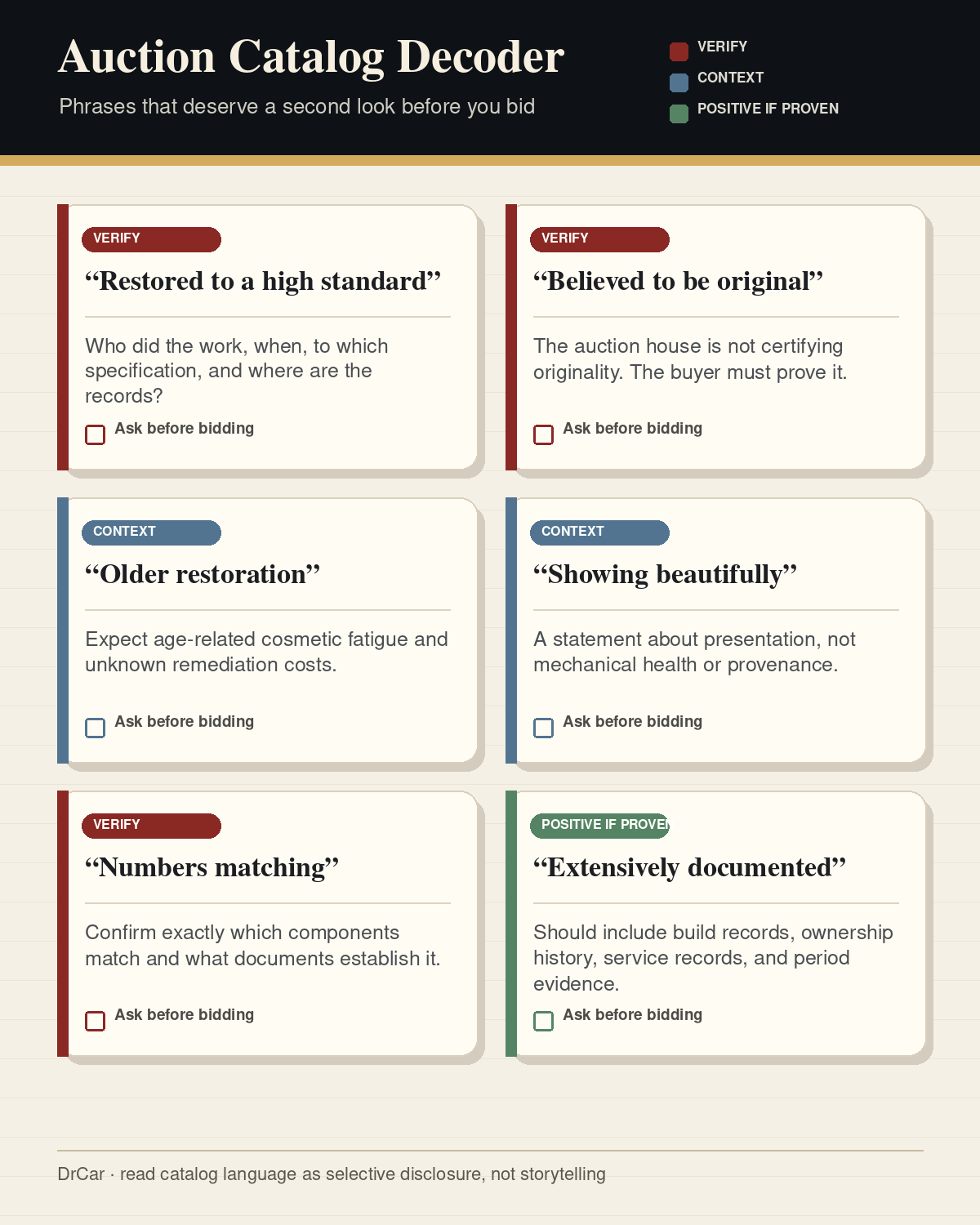
A quick-reference decoder for auction catalog phrases that sound reassuring but require verification.
“Restored to a high standard”
This phrase confirms that the car has been restored — but deliberately leaves the date, scope, and quality of that restoration open to interpretation. “High standard” is entirely subjective and unverifiable from the catalog alone. The critical questions it raises: restored when, by whom, to what specification, and with what documentation?
A car described this way may be exceptional. It may also be a recent rotisserie job designed to obscure deferred original maintenance. Ask for the restoration records before bidding.
“Believed to be original”
Three words that should trigger immediate scrutiny: believed, to be, and original each introduce uncertainty. “Believed” signals that the house is not prepared to certify what follows. “To be original” confirms that originality is in question. This phrase appears most often in descriptions of components — paint, trim, mechanical elements — where factory documentation is absent or incomplete.
It is not necessarily disqualifying. Many genuine cars carry this language because comprehensive factory records simply don’t exist for their era. But it shifts the burden of verification entirely to the buyer.
“Older restoration”
This is auction shorthand for: the restoration was done some years ago, its quality at the time is unknown to us, and its current condition has been affected by subsequent use, storage, or elapsed time. An older restoration on an otherwise well-presented car often means respectable underlying structure but cosmetic fatigue — paint crazing, chrome pitting, interior wear — that will require attention.
The phrase is honest in its way, but it asks you to mentally price in an unknown quantity of remediation work.
“Showing beautifully”
Surface-level praise. This phrase describes how a car presents visually — in photographs, under auction house lighting, at viewing distance. It says nothing whatsoever about mechanical condition, originality, or structural integrity. A car that “shows beautifully” may have cosmetic work concealing more complicated underlying issues.
Take it as a statement about photography, not provenance.
“Numbers matching”
The single most important phrase in collector car auctions — and one of the most frequently misapplied. In its strictest meaning, it indicates that major stamped or tagged components (engine, transmission, rear axle) carry codes that correspond to the vehicle’s original factory build record.
But “numbers matching” is not a uniform standard. Some houses use it to mean the engine number matches factory documentation. Others use it loosely to mean the components present are the correct type for the year and model, regardless of whether they were the original units installed. Before bidding on any car described as numbers matching, confirm the specific components referenced and how correspondence was established.
“Extensively documented”
Documentation is valuable precisely because it is scarce. A car described as extensively documented should be able to demonstrate: factory build records or order sheets, ownership history, service records, and — ideally — photographic or competition records from earlier in its life.
Ask to see it before the sale. Extensive documentation in the catalog that turns out to be a folder of receipts from the most recent owner’s tenure is not what the phrase implies.
Provenance Language: Reading the Ownership Narrative
“Single-family ownership”
One of the more genuinely positive phrases in auction catalog vocabulary, when verifiable. A car held by one family across decades tends to have consistent maintenance philosophy, documented history, and — often — original components preserved by owners who valued the car as an artifact rather than a commodity.
The caveat: “single-family” can describe three generations of neglectful storage as readily as three generations of careful stewardship. The phrase establishes continuity of ownership; it does not establish quality of care.
“From a significant private collection”
This phrase operates on several levels. When the collection is named or identifiable, it can be genuinely meaningful — collections assembled by serious, knowledgeable owners tend to contain well-sourced, appropriately maintained vehicles. When the collection is anonymous, the phrase functions primarily as a status signal with no verifiable content.
Ask the house to identify whose collection. If they decline, treat the phrase as decorative.
“Fresh to the market”
Translation: not widely known, not previously offered at auction, possibly unexplored in terms of its full condition and history. This can mean genuine discovery — a barn find, a private sale car appearing publicly for the first time — or it can mean a car that previous sellers were unable to move through private channels. Both readings are possible. Fresh to market warrants curiosity, not assumption.
“Offered without reserve”
A structural signal rather than a condition descriptor: the seller is committed to selling regardless of final price. This tends to concentrate bidder interest and can create either opportunity or competitive pressure depending on how the room reads the car. On a genuinely desirable lot, no-reserve can drive prices well above estimate. On a car with unresolved questions, it may suggest the seller’s preference for certainty over price.
The Language of Estimates
Auction estimates are not appraisals. They are starting points for negotiation, set by specialists who balance market data, seller expectations, and bidder appetite. A car estimated above recent comparables may reflect optimism or private knowledge of genuine scarcity. A car estimated below comparables may be positioned to generate competitive momentum — or may reflect questions the house is not surfacing in the catalog description.
When a lot carries an estimate that seems materially inconsistent with its described condition and provenance, the inconsistency is worth investigating before bidding day.
What the Catalog Doesn’t Say
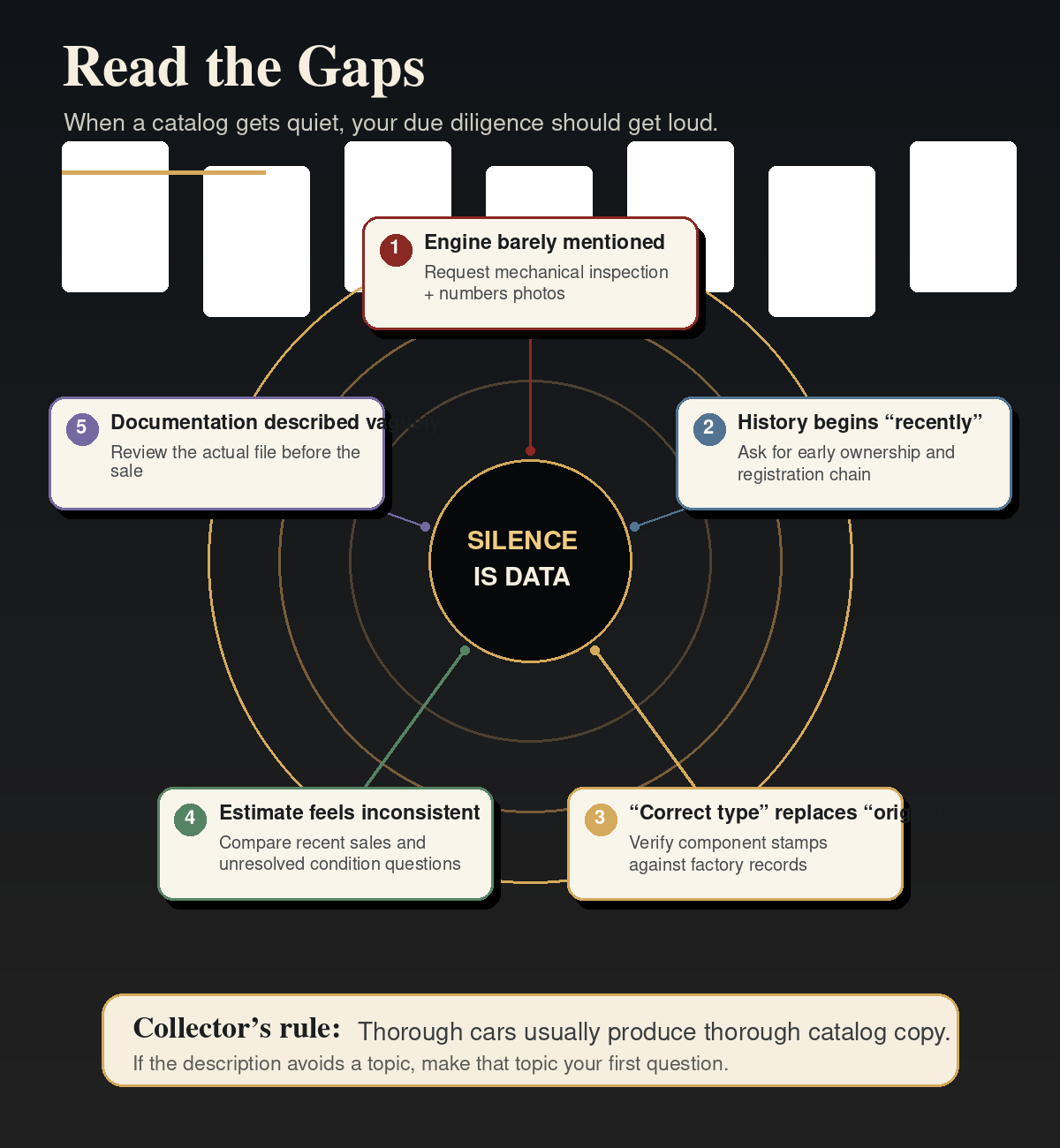
The most important auction language is sometimes the subject the catalog avoids.
The most significant information in an auction catalog is often its absence. A description that covers exterior presentation, interior condition, and ownership history but does not mention the engine — beyond confirming it is the “correct” type — is telling you something. A provenance summary that accounts for recent decades but goes silent on the car’s history before 1990 is worth noting.
Well-documented, thoroughly sound vehicles tend to generate thorough catalog descriptions. When the writing covers some topics in depth and leaves others untouched, read the gaps carefully.
The auction catalog is a document of selective disclosure. Experienced collectors read it for what is present, for what is absent, and for the precise choice of words in between.
Provenance defines value. Reading the language that describes it is where the work starts.
Get our exclusive “Auction Decoder Key” with explanations of 50+ critical auction terms and their hidden meanings.