

Provenance defines value. For collectors, a FIVA ID Card for classic cars provides an independently checked record of a vehicle’s identity, specification, condition, known history, and modifications at inspection. It is not proof of authenticity or complete ownership history. That distinction determines how much weight the card deserves in a provenance file. Any serious collector knows that what a car is matters less than what can be proved about it. That’s the space the FIVA ID Card occupies — and understanding exactly what it does and doesn’t certify will sharpen how you use it.
What the FIVA ID Card Actually Is
The Fédération Internationale des Véhicules Anciens — FIVA — is the governing body for historic vehicles on the international stage. Its ID Card is an internationally recognized document that records a vehicle’s identity, physical condition, and known history at the time of inspection. Think of it as a structured, independently issued dossier: not a stamp of authenticity, but a verified snapshot.
The card is issued under the FIVA Technical Code, the organization’s framework for classifying and assessing historic vehicles. It captures specifics: make, model, year of manufacture, body style, engine details, drivetrain configuration, and observable modifications. When modifications are present, they’re logged — not penalized by default, but documented clearly.
That distinction matters. A FIVA ID Card doesn’t declare a car original. It declares what was observed, when, and by whom.
What the Card Proves — and Where Its Limits Are
A FIVA ID Card for classic cars is credible because it is issued after a physical inspection by a qualified FIVA member federation representative. The inspector examines the vehicle directly, cross-references manufacturer data, and notes the condition and any deviations from original specification.
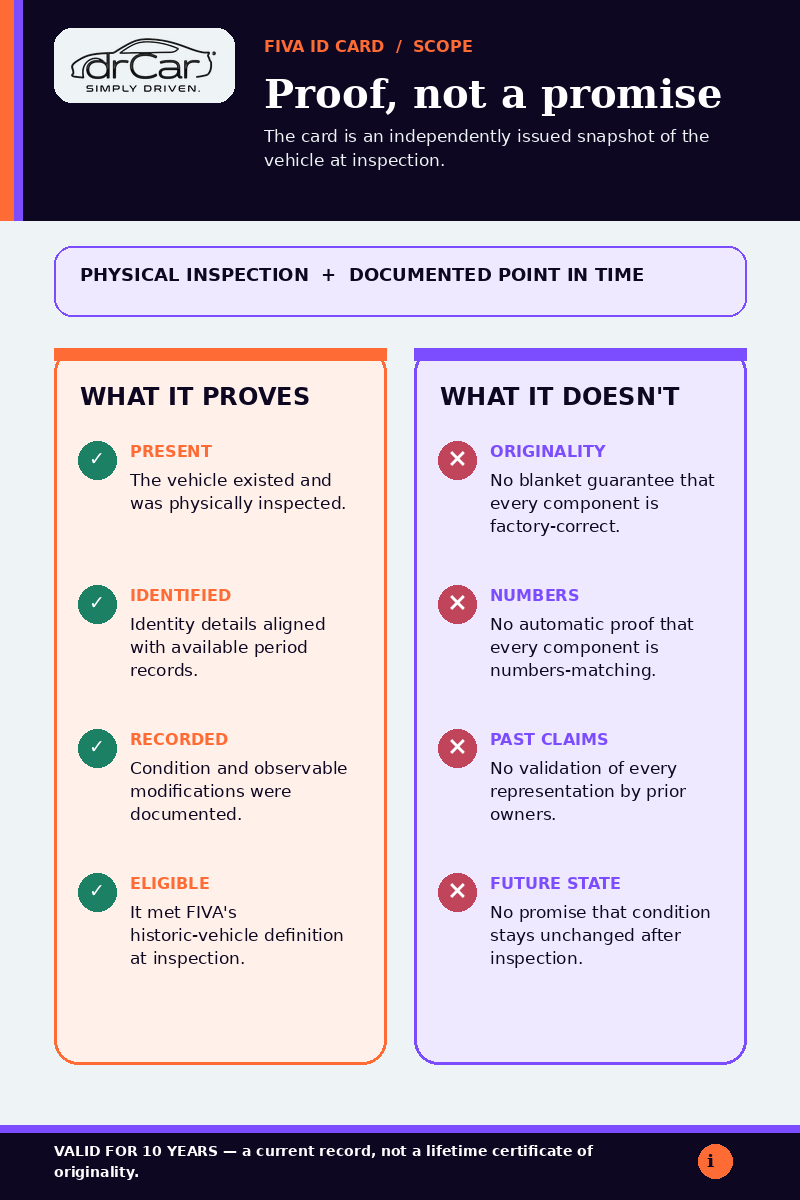
What the card confirms:
- The vehicle exists as described and was physically present for inspection
- Its identity details align with available period documentation
- Its condition and modification status were assessed at a specific point in time
- It meets FIVA’s definition of a historic vehicle under the Technical Code
What the card cannot confirm:
- That all components are numbers-matching or factory-correct beyond observable records
- That the vehicle has never been misrepresented in prior ownership
- That condition has remained unchanged since issuance
The ten-year validity period is deliberate. A car’s condition, documentation, and modification status can shift. FIVA treats the card as a living record — relevant and current for a decade, then requiring renewal to remain credible.
Eligibility Requirements
To qualify for a FIVA ID Card, a vehicle must meet several baseline criteria:
- Age: At least 30 years old from the year of manufacture
- Type: A road vehicle — cars, motorcycles, trucks, buses, and similar are eligible
- Preservation: Must be maintained in a historically correct condition, meaning it is not modified for improved performance, comfort, or safety beyond what was available in its era
- Period documentation: Supporting records strengthen the application; while not always mandatory, they carry significant weight during inspection
Vehicles that have been substantially modified for track use, modernized mechanically, or structurally altered beyond period norms typically do not qualify.
The Application and Inspection Process
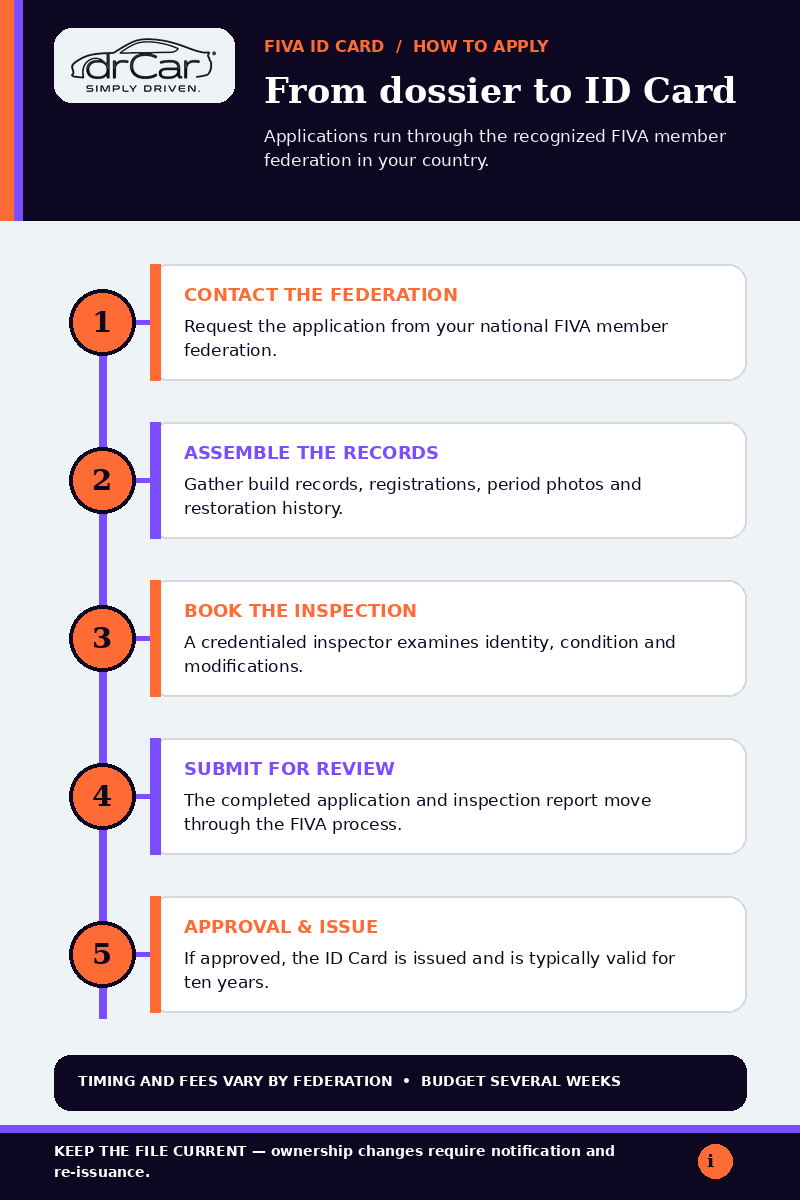
The process runs through your national FIVA member federation. FIVA itself doesn’t issue cards directly — it operates through an international network of recognized national clubs and associations. In the United States, that body is the Antique Automobile Club of America (AACA). In the UK, it’s the Federation of British Historic Vehicle Clubs (FBHVC).
Step one: Contact your national member federation and request an application. The form collects vehicle details, ownership information, and documentation references.
Step two: Submit supporting documentation. Factory build records, chassis certificates, period photographs, previous registration documents, and restoration records all strengthen the file.
Step three: Arrange the physical inspection. A credentialed inspector will examine the vehicle, verify its identity against the application, and complete the FIVA inspection form.
Step four: The completed application and inspection report are submitted to FIVA. Upon approval, the card is issued — typically valid for ten years from the inspection date.
Fees and processing timelines vary by federation. Budget several weeks minimum; some federations work on seasonal schedules tied to the show calendar.
Ownership Changes and Re-Issuance
When a vehicle changes hands, the FIVA ID Card does not automatically transfer with full standing. The new owner must notify their national federation and apply for a reissuance under their name. In most cases, if the vehicle hasn’t materially changed, the inspection record carries forward — but the ownership details must be updated before the card holds weight for the new holder at events or during transactions.
This is worth understanding before purchase. A car being sold with a FIVA card is more useful than one without — but buyers should confirm the card is current, valid, and transferable. Request documentation of any prior inspection reports as part of due diligence.
Where the FIVA ID Card Carries Weight
Concours and historic events. Many of the world’s leading concours d’élégance and historic rallies use the FIVA ID Card as a qualifying or entry-streamlining document. Events affiliated with FIVA’s international calendar may require one for participation. It signals that a vehicle has passed independent scrutiny — which matters in competitive judging contexts.
Cross-border movement. For collectors who move vehicles between countries — particularly within Europe — the FIVA ID Card can simplify customs and regulatory documentation. It provides a standardized international identity record that customs officials and registration authorities in many countries recognize.
Insurance and valuation. Some specialist insurers and independent valuers accept the FIVA ID Card as supporting documentation when establishing agreed value policies. It doesn’t replace a formal appraisal, but it adds a credible third-party layer to the dossier.
Private sales and auction provenance. A current FIVA card in the file tells a prospective buyer that the vehicle was inspected, documented, and deemed eligible under an international standard. When reviewing high-end market listings, understanding classic car auction catalog terminology helps decode lot descriptions alongside third-party passport files. It doesn’t guarantee originality — but it narrows the uncertainty, and that has measurable value in negotiation.
Building a Complete Provenance File
The FIVA ID Card is one piece of a well-constructed provenance file — not the whole picture. Investment-grade historic vehicles carry multiple layers of documentation:
- Factory production records or certificate of authenticity from the manufacturer archive
- Continuous ownership history (ideally with period photographs)
- Service and restoration records with receipts and parts provenance
- Competition history documentation where applicable
- Specialist marque club certification
- And, for internationally traded vehicles, the FIVA ID Card
Think of it as due diligence by documentation. The more independently verified each layer, the more defensible the car’s story — and the more confidently a serious buyer will act.
The Bottom Line
A FIVA ID Card for classic cars is a credible, internationally standardized record of what a vehicle is and what condition it was in at the time of inspection. It’s not a blanket guarantee of originality, and it doesn’t override the need for independent specialist assessment before a significant acquisition.
What it is: the clearest internationally recognized signal that a vehicle has been physically examined, its identity verified, and its status documented under a respected framework. For concours-eligible and globally significant historic vehicles, it’s investment-grade documentation — and the absence of one from a serious collector’s file invites unnecessary questions.
If your vehicle qualifies and doesn’t yet carry a FIVA card, the process is worth completing. Scarcity of credible provenance documentation is one of the few factors in this market that collectors consistently underinvest in — until the moment it matters most.
Join DrCar’s Classic Cars discussion and share which provenance document you trust most before buying.