


1996 cars becoming classics in 2026 cross an age threshold, but 30 years alone does not confer formal historic status or collector value. Under FIVA’s definition, a vehicle must also be preserved and maintained in historically correct condition, not used as daily transport, and recognized as part of technical and cultural heritage. Five collector tests help separate preservable examples from cars that are simply getting older.
A vehicle born thirty years ago doesn’t become a classic by surviving. It earns that designation by meaning something.
The calendar has a way of making declarations that the market quietly anticipated for years. During 2026, surviving cars built in 1996 reach the 30-year age threshold in FIVA’s historic-vehicle definition. Thirty years. That’s the line.
But the line doesn’t do the work for you. The 30-year classic car rule is an organizational benchmark, not an appraisal or an automatic legal designation. What separates a genuine artifact from an aging appliance is something more nuanced, and more human, than a calendar date.
What the 30-Year Rule Means for 1996 Cars Becoming Classics
FIVA’s definition of a historic vehicle is built on age and preservation — not rarity alone, not price, not nostalgia. A vehicle must be at least 30 years old, preserved and maintained in historically correct condition, no longer used as daily transport, and regarded as part of technical and cultural heritage.
That last part matters. FIVA is not a national licensing authority, so the effect varies by jurisdiction. Depending on local rules, insurers, and event organizers, historic recognition may affect insurance options, inspection or emissions treatment, and eligibility for historic rallies or concours events. For 1996 modern classics making the crossing, that can change how owners document, preserve, and use them.
The youngtimer vs classic car distinction has always been fluid in conversation, but FIVA draws an age-based boundary: youngtimers are 20 to 29 years old, while vehicles become eligible for historic classification at 30 if they satisfy the remaining conditions. A 1996-built car therefore becomes age-eligible as it reaches its 30th anniversary in 2026; age alone is not enough. Owners considering formal documentation can also review DrCar’s guide to the FIVA ID Card for classic cars.
5 Essential Tests for 1996 Cars Becoming Classics
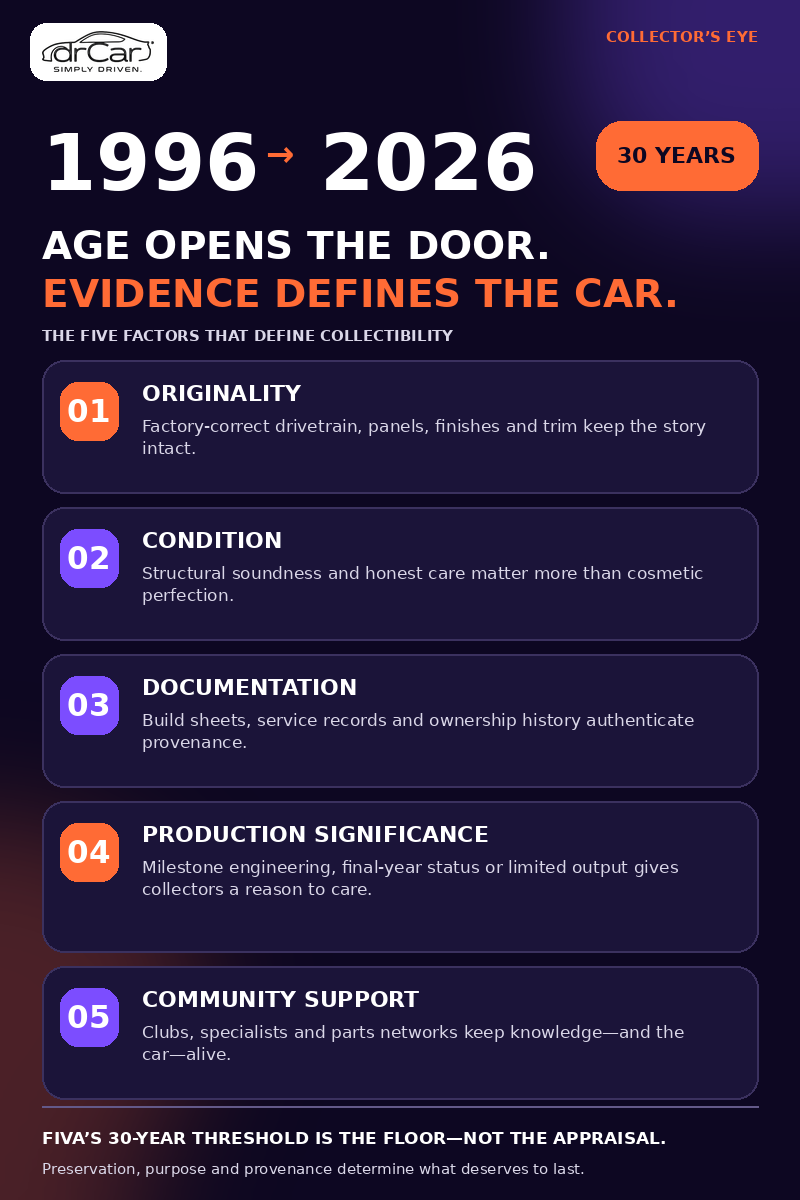
Not every 1996 vehicle crossing this threshold will become a future collectible car. Most won’t. The FIVA historic vehicle definition is a floor, not a ceiling. What separates a preservable modern classic from a merely old used car comes down to five converging factors.
1. Originality
Numbers-matching matters here just as it always has. An original drivetrain, untouched body panels, factory paint codes, and period-correct interior materials tell a complete story. Every non-original substitution — however well-intentioned — breaks a link in that chain. The car that was never “improved” is often more valuable than the one that was carefully restored.
2. Condition
Condition is not the same as cosmetic appearance. A driver-quality car with honest patina and solid mechanicals frequently carries more integrity than a trailer-queen restoration that replaced everything. What evaluators look for is structural soundness, functional completeness, and the absence of deferred deterioration. Originality and condition work together; neither compensates for the absence of the other.
3. Documentation
Provenance can shape value. Factory build sheets, original window stickers, service records, title history, photographs from early ownership — these are the artifacts that authenticate a vehicle’s story. A 1996 car arriving in 2026 with a thick folder of documentation is not the same object as an identical example that appeared from nowhere. The paper trail is part of what you’re preserving, and DrCar’s guide to classic-car auction terminology explains how sellers signal gaps and strengths in that history.
4. Production Significance
Some 1996 models were produced in enormous volumes and will never be scarce. Others represent final years of a platform, limited production runs, factory performance variants, or engineering milestones. The 1996 cars becoming classics that command serious long-term attention tend to have a reason to exist beyond mere transportation — a story embedded in their manufacturing that collectors will keep telling.
5. Community Support
Marque clubs, technical registers, parts suppliers, and specialist restorers are the infrastructure that keeps a historic vehicle viable over decades. A car without a community is a car without a future. Active owner networks maintain parts availability, technical knowledge, and the cultural energy that sustains values. When evaluating any emerging classic, ask not just what the car is — ask who cares about it.
1996: A Snapshot of the Threshold
The mid-1990s produced vehicles that now look, in retrospect, like the last expressions of a certain era of automotive design and manufacture — before widespread adoption of electronic stability systems, before the shift away from naturally aspirated performance, before the homogenization of global platforms.
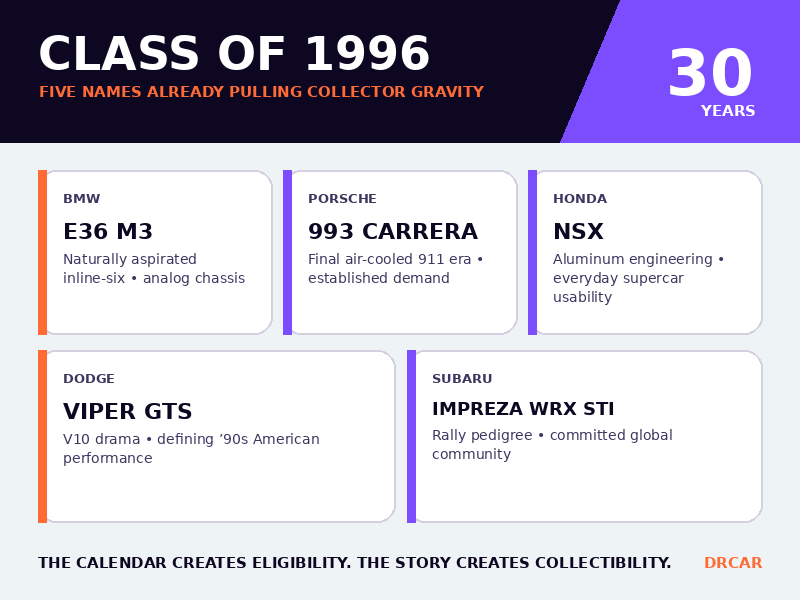
Some significant names from 1996 that are now drawing genuine collector attention:
- BMW E36 M3 — A benchmark 1990s performance coupe whose naturally aspirated inline-six, balanced chassis, and strong enthusiast network continue to attract collectors; specifications vary significantly by market.
- Porsche 993 Carrera — The final air-cooled 911, a distinction that has made every variant of this generation an investment-grade artifact.
- Honda NSX — Japanese engineering precision meeting supercar performance in a format that has aged remarkably well both mechanically and aesthetically.
- Dodge Viper GTS — American performance at its most uncompromising, now recognized as a defining expression of 1990s performance culture.
- Subaru Impreza WRX STI — A rally-derived platform with genuine competition heritage and a global ownership community that has never lost enthusiasm.
These are collector-candidate starting points, not blanket investment recommendations. Exact build date, market specification, originality, documentation, and condition determine whether an individual example deserves serious preservation.
What This Means If You’re Looking
If you’re approaching the 1996 threshold as a collector or first-time historic vehicle buyer, the guidance is the same as it has always been: buy the history, not just the car. A well-documented, unmodified example in honest condition is often a stronger preservation candidate than a superficially cleaner car with modifications or gaps in its story.
The crossing from youngtimer to classic is a cultural shift as much as a regulatory one. The cars that make this transition with their integrity intact — original, documented, supported by community, and significant by their own production history — are the ones worth preserving.
The others are just getting older.
Your Turn
Nominate the 1996 model DrCar should preserve for the next generation — and share the story that makes it matter.
Which car born in 1996 deserves to be remembered? Tell us what you drove, what you owned, or what you watched cross a finish line that year. The artifacts worth keeping are the ones with stories attached to them. We want to hear yours.