


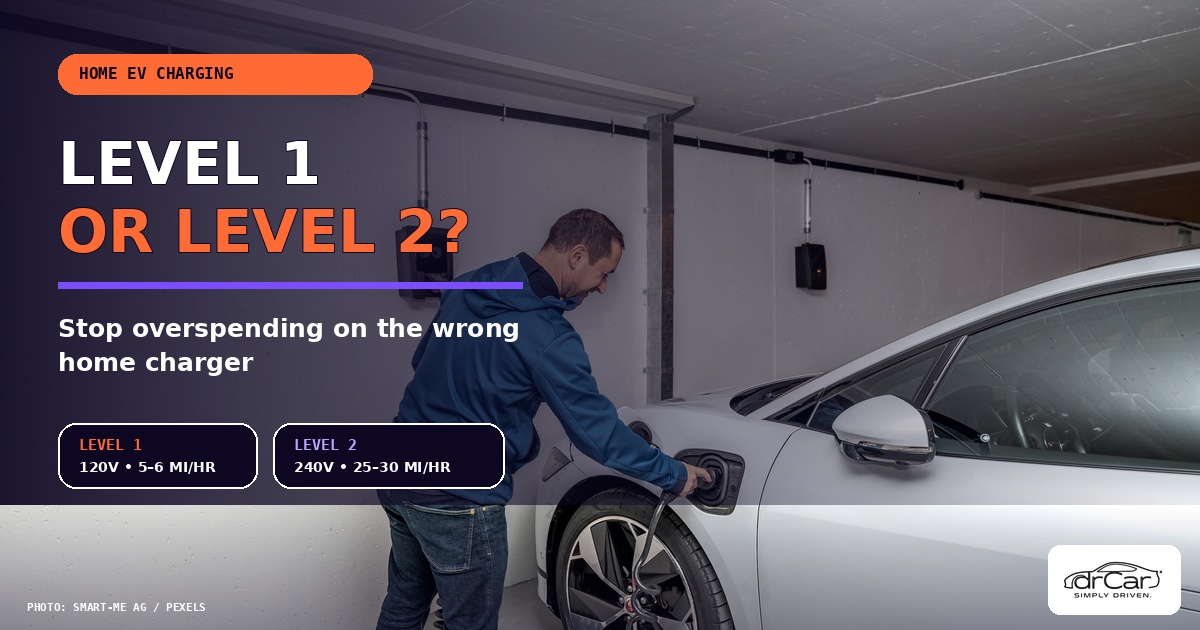
Level 1 vs Level 2 EV charging comes down to daily mileage, overnight parked time, and electrical-panel capacity. Level 1 uses a standard 120-volt outlet and commonly adds about 3–5 miles of range per hour, while Level 2 uses a 240-volt circuit and commonly adds 10–30 miles per hour. The right charger is the one that recovers the energy you actually use before your next drive — not the one with the highest kilowatt rating on the box.
Here’s how to figure out which one that is.
The Numbers That Actually Matter
Before touching a spec sheet, answer three questions:
- How many miles do you drive daily? (Use your average, not your worst week.)
- What is your vehicle’s energy consumption? (Typically 2.5–4 miles per kWh — check your owner’s manual or window sticker.)
- How many hours is the car parked and plugged in overnight?
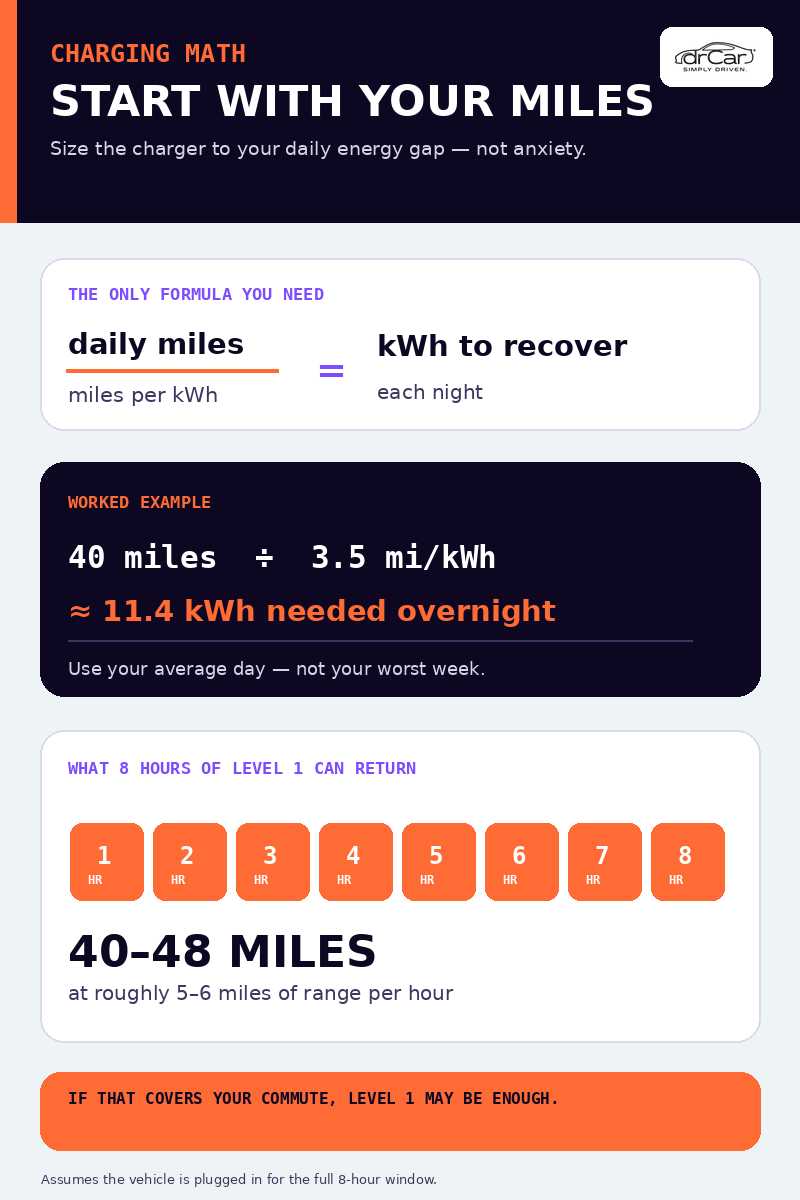
Run the formula:
kWh needed = daily miles ÷ miles per kWh
A driver covering 40 miles at 3.5 miles/kWh needs about 11.4 kWh recovered overnight. A standard 120-volt Level 1 outlet delivers roughly 1.3–1.5 kW. Depending on the vehicle and charging losses, eight hours may recover roughly 10–12 kWh — potentially enough to replace that driver’s typical day. The U.S. Department of Energy’s home-charging guide likewise notes that many drivers can meet daily range needs with overnight Level 1 charging when a suitable dedicated branch circuit is available.
That driver may not need a Level 2 charger. They need a suitable grounded outlet on a dedicated branch circuit, confirmed safe for continuous charging.
Level 1 vs Level 2 EV Charging: Comparing Speeds and Setup Costs
Level 1 charging uses a standard household outlet — 120 volts, typically on a 15- or 20-amp circuit. Many EVs include a compatible portable cord, while others sell one separately. If a suitable dedicated outlet already exists near the parking space, no wall unit or new circuit may be needed; have questionable, old, damaged, or shared wiring evaluated before continuous charging.
Level 1 works well when:
- Your daily commute is under 40–50 miles round-trip
- The car is parked for 8 or more hours overnight
- Your battery is 40–75 kWh (most compact and mid-size EVs)
- You have access to workplace or destination charging that handles longer days
The hidden advantage is simplicity: when an existing circuit is suitable, Level 1 can cover routine driving without buying a wall-mounted EVSE or adding a 240-volt circuit. Battery longevity depends more on temperature, time spent at very high states of charge, and manufacturer guidance than on a blanket Level 1-versus-Level 2 rule.
The firm requirement: use a grounded outlet on a dedicated branch circuit sized for the charger’s continuous load. Sharing a circuit with a refrigerator or workshop tools can cause nuisance tripping and may overload unsuitable wiring. Have a qualified electrician evaluate the circuit if its condition or capacity is uncertain.
Level 2: The Right Tool for Specific Situations
Level 2 charging operates at 240 volts — the same supply that runs a clothes dryer. A 32-amp Level 2 unit delivers roughly 7.2 kW, recovering 25–30 miles of range per hour. A 48-amp unit pushes closer to 11.5 kW.
Level 2 justifies its cost when:
- Daily mileage consistently exceeds 50–80 miles
- Your EV carries a large battery (80–100+ kWh) that Level 1 cannot replenish in a single night
- Your schedule is irregular — you need a full charge in 4 hours, not 10
- You own two EVs sharing one home circuit
- Your vehicle is a plug-in hybrid with a small battery but short charge windows
A proper Level 2 installation typically requires a dedicated 240-volt circuit, safety-certified EVSE, outdoor-rated equipment when exposed to weather, and any permits required by the local authority. Installation cost varies widely with panel capacity, cable distance, local labor, and whether service upgrades are needed, so obtain a site-specific quote from a qualified electrician.
The Electrical Panel Question Nobody Mentions in the Marketing
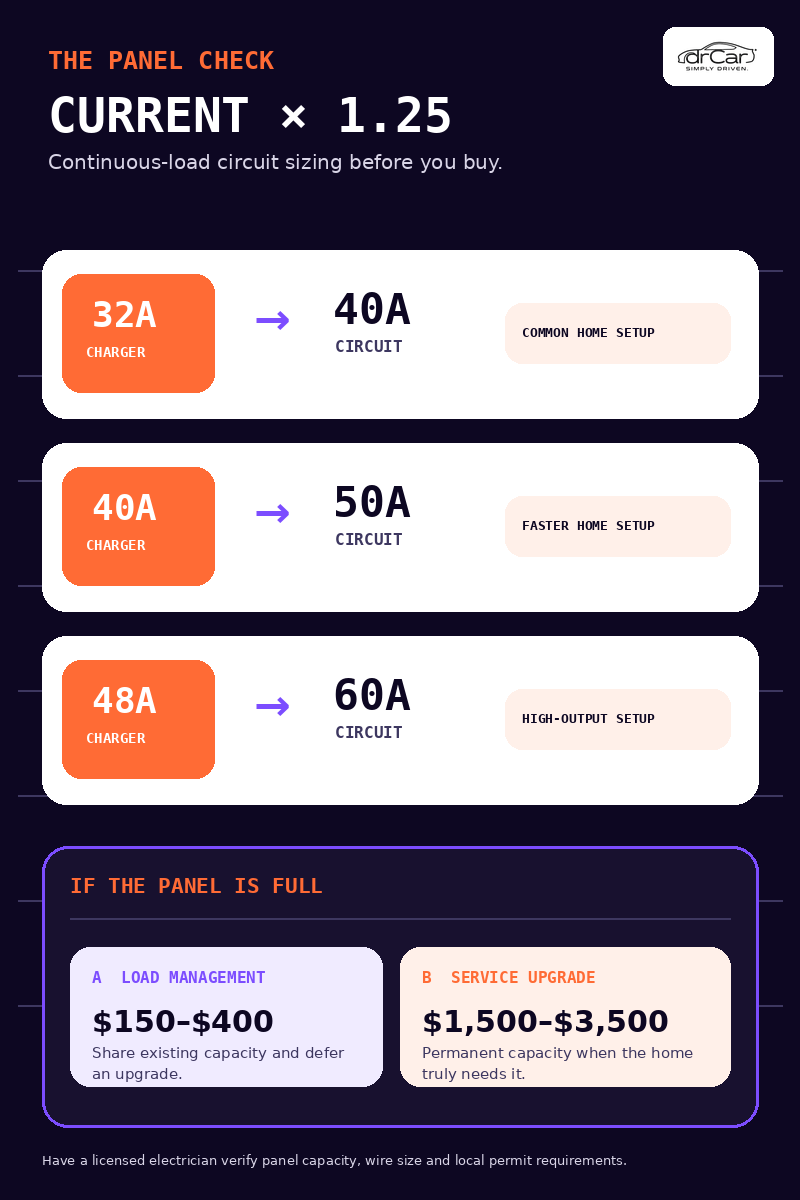
Before scheduling an installation, have your main panel and service capacity checked. A 48-amp Level 2 charger draws 48 amps continuously and commonly requires a 60-amp circuit because EV charging is treated as a continuous load. Conductor size and installation method depend on the applicable electrical code, equipment instructions, temperature ratings, and local conditions; a qualified electrician should make that determination.
If your panel lacks capacity, possible solutions include an approved load-management system that controls charging around other household loads, a lower-amperage Level 2 circuit, or a panel or service upgrade. Availability and cost vary by home and jurisdiction.
Where a permit is required, use the local permitting and inspection process. Keep the permit, inspection record, equipment listing, and installer invoice with your home records, and ask your home insurer whether it wants permanent charging equipment documented.
Smart Charger Features: Worth It or Not?
A smart Level 2 charger adds Wi-Fi scheduling, energy monitoring, and time-of-use rate integration. If your utility offers lower off-peak rates, scheduling sessions into that window can reduce charging costs. Whether a smart charger’s price premium pays back — and how quickly — depends on the local rate plan, driving volume, and whether the vehicle already provides equivalent scheduling.
Non-smart chargers can accomplish the same thing if your EV’s on-board charging scheduler lets you set a departure time. Check your vehicle’s app or settings before upgrading to a smart unit.
One certification rule that is non-negotiable: choose EVSE certified by a nationally recognized testing laboratory to the applicable safety standard. UL Solutions identifies ANSI/UL 2594 as the standard for electric vehicle supply equipment. Uncertified units do exist online at lower price points; do not use them. The same buy-certified principle matters across electric mobility, including the battery systems covered in DrCar’s e-bike battery safety guide.
If charging equipment becomes a permanent garage fixture, confirm with your home insurer how it is treated and retain the installation permit, inspection record, and receipt.
The Decision Map
| Your Profile | Recommended Solution |
|---|---|
| Under 40 miles/day, 8+ hours parked | Level 1, dedicated 20A outlet |
| 40–80 miles/day, standard schedule | Level 1 with a load check; Level 2 if nights are short |
| 80+ miles/day or large battery | Level 2, 32–48A circuit |
| Two EVs, shared panel | Level 2 with load management |
| Irregular schedule, need fast top-up | Level 2, any range |
The charger that works is the one sized to your commute — not the one sized to anxiety about running out.
Build Your Charging Decision
Your commute, your vehicle’s efficiency rating, and your overnight parking window are the only variables that matter. Share those details with DrCar and we will map the exact charging setup — outlet spec, circuit size, estimated install cost, and time-of-use savings — for how you actually drive.
Every mile is a choice. Make the infrastructure behind it just as deliberate.