

E-bike battery safety comes down to four basics: buy a certified electrical system, use only its approved charger, charge and store it away from exits and flammable materials, and recycle the pack through a trained collection site. These habits help prevent battery damage or charging mistakes from becoming a fire.
E-bikes are everywhere — on delivery routes, in apartment lobbies, parked in living rooms, and plugged into hallway outlets overnight. Most rides end without incident, but lithium-ion fires linked to e-mobility devices are a reason to understand your battery rather than fear it.
Start With Certification — Before You Buy
The single most effective thing you can do for e-bike battery safety is buy a bike with a certified battery system. Look for UL 2849 certification, which covers the entire e-bike electrical system — battery, motor, and charger together. The UL 2271 standard applies specifically to the battery pack itself.
Certification means the system has been independently tested against defined safety requirements. UL Solutions explains that UL 2849 evaluates the electrical drive train, battery, and charger as a system. It is not merely marketing language.
If a listing does not identify certification by a recognized testing laboratory, treat that as a red flag — especially for aftermarket battery replacements or deep-discount imports.
What to look for at purchase:
- UL 2849 (full e-bike system) or UL 2271 (battery pack)
- Battery and charger sold as a matched pair from the same brand
- A model that appears on the manufacturer’s recall and service notification list
- Clear documentation of the battery’s cell chemistry and rated cycle life
E-Bike Battery Safety: Use the Right Charger Every Time
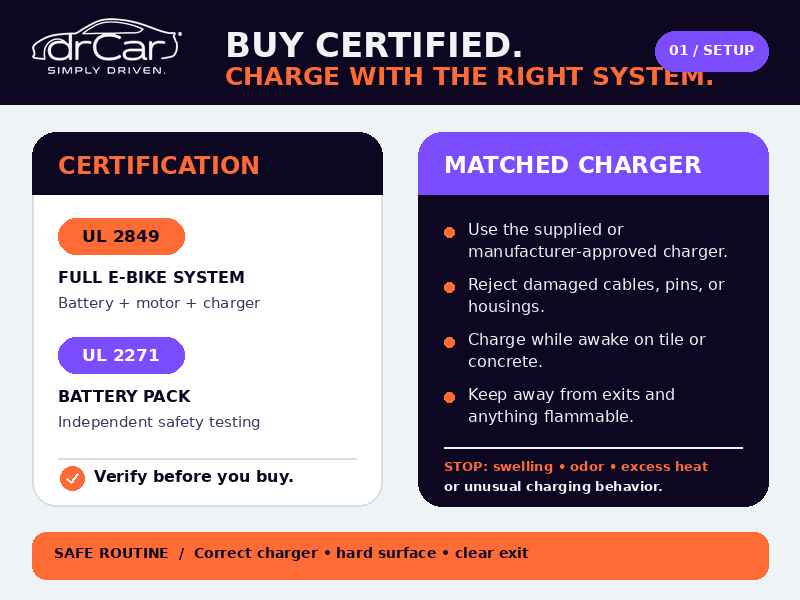
Mismatched chargers are a leading cause of lithium-ion battery fires. The charger that came with your e-bike was engineered for that specific battery’s voltage, chemistry, and charge profile. A third-party charger that outputs a slightly higher voltage or lacks the right cutoff logic can push a battery into an unsafe state — quietly, over dozens of charge cycles, before the problem becomes visible.
E-bike charging safety rules:
- Only use the charger supplied with the bike or one explicitly approved by the manufacturer
- Never use a charger with a damaged cable, bent pins, or a cracked housing
- Don’t charge with an extension cord unless it’s rated for the full load
- Never leave a charging battery unattended for long periods — especially overnight
- Stop using any battery that gets unusually hot during charging, takes significantly longer to charge than normal, or shows visible swelling
A battery that charges to full and stays cool is doing its job. One that surprises you is asking for attention.
Where You Charge Matters More Than You Think
For apartment residents and urban riders, charging location is the highest-impact decision you can make. Lithium ion battery fire prevention starts with keeping ignition sources away from escape routes.
Where to charge:
- On a hard, non-flammable surface (concrete, tile, or a fire-resistant mat)
- Away from flammable materials — curtains, furniture, clothing, paper
- In a space with a working smoke detector within range
- Where the exit door or hallway is not blocked by the bike or charging setup
Where not to charge:
- In the hallway blocking the only exit
- In a bedroom while you’re asleep
- In a closet or enclosed cabinet with no airflow
- Near heat sources or in direct sunlight
Some apartment buildings and cities now restrict indoor e-bike storage and charging — check your building rules. Newer buildings in fire-prone areas are installing dedicated e-bike charging stations in parking garages or bike rooms, which is the cleanest solution if available.
E-Bike Battery Storage Between Rides
Batteries that sit unused for extended periods need attention too. Storing a fully depleted or fully charged battery for weeks accelerates cell degradation and, in the case of damaged cells, can create conditions for slow thermal events.
For e-bike battery storage:
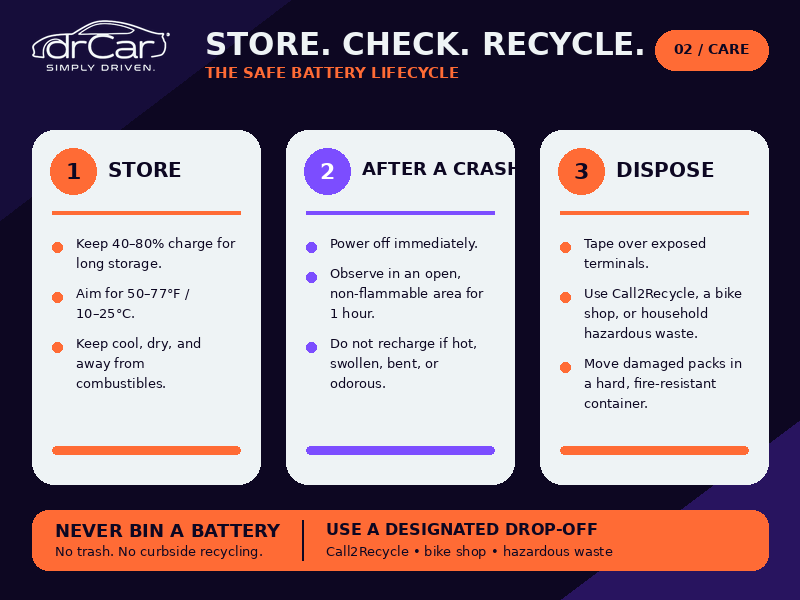
- Store at 40–80% charge for periods longer than a few weeks
- Keep in a cool, dry location — ideally between 50°F and 77°F (10°C–25°C)
- Avoid garages or sheds that get very hot in summer or freeze in winter
- Inspect the battery every few weeks during long storage periods; look for swelling, leaks, or unusual odor
- Store away from flammable materials even when not charging
If you’ve been in a collision — even a minor one — inspect the battery carefully before charging again. Impact damage isn’t always visible externally, but it can compromise the internal cell structure. When in doubt, have it checked by the manufacturer or a certified shop before plugging in.
Post-Crash Protocol
A dropped or crashed e-bike shouldn’t go straight back on the charger.
After any significant impact:
- Power off the bike immediately
- Move the battery to an open, non-flammable area if you can safely remove it
- Wait and observe for at least an hour — thermal runaway from physical damage can be delayed
- Look for deformation, swelling, heat, or electrolyte smell
- Contact the manufacturer before charging if you have any doubt
This isn’t overcaution. Thermal runaway in a compromised lithium cell can develop slowly over hours. Getting the bike to a professional before charging is the right move after anything more than a soft tip-over.
Disposing of a Dead Battery the Right Way
Lithium-ion batteries don’t belong in the trash or the recycling bin. They belong at a designated drop-off point.
For e-bike battery disposal:
- Use The Battery Network locator to find a trained collection site that accepts your e-bike battery brand
- Many bike shops and sporting goods retailers accept used lithium batteries
- Some municipalities have hazardous household waste collection days
- Never put a damaged or swollen battery in a bag — transport it in a fireproof container or hard case
Before disposal, tape over the terminals with electrical tape to prevent short circuits during transport and handling.
The Practical Summary
You don’t need to stop charging indoors or wrap your e-bike in fear. You need a UL certified e-bike, the matched charger, a sensible location, and basic observation habits. Most riders who’ve had fires weren’t being careless in an obvious way — they were using uncertified batteries or chargers, or charging somewhere that made a small event into a large one.
Designed for how you actually move means building these habits into your routine, not adding steps. Charge when you’re awake. Charge away from exits. Use the right charger. Inspect after impact. Recycle properly. For a broader view of next-generation transportation, explore DrCar’s guide to urban air mobility and eVTOL aircraft.
That’s the whole system.
Share your safe charging routine in DrCar’s Alternative Vehicles community and help new riders avoid risky shortcuts. Whether you’ve found a great indoor charging setup, a local battery recycling spot, or learned something the hard way — your real-world experience is exactly what new riders need to hear.