

You’ve done your homework. You’ve watched the in-car footage, registered for the High Performance Driving Education event, scrubbed the tire pressures, and packed the helmet. What you probably haven’t done is call your insurance agent. That oversight could cost you a car.
Most drivers assume that because they drove their vehicle to the track legally, on public roads, their personal auto policy follows them through the gate. It doesn’t. Understanding track day insurance coverage — and the gap that catches drivers off guard — is one of the most important things you can do before you ever enter pit lane.

The Standard Exclusion You Probably Didn’t Read
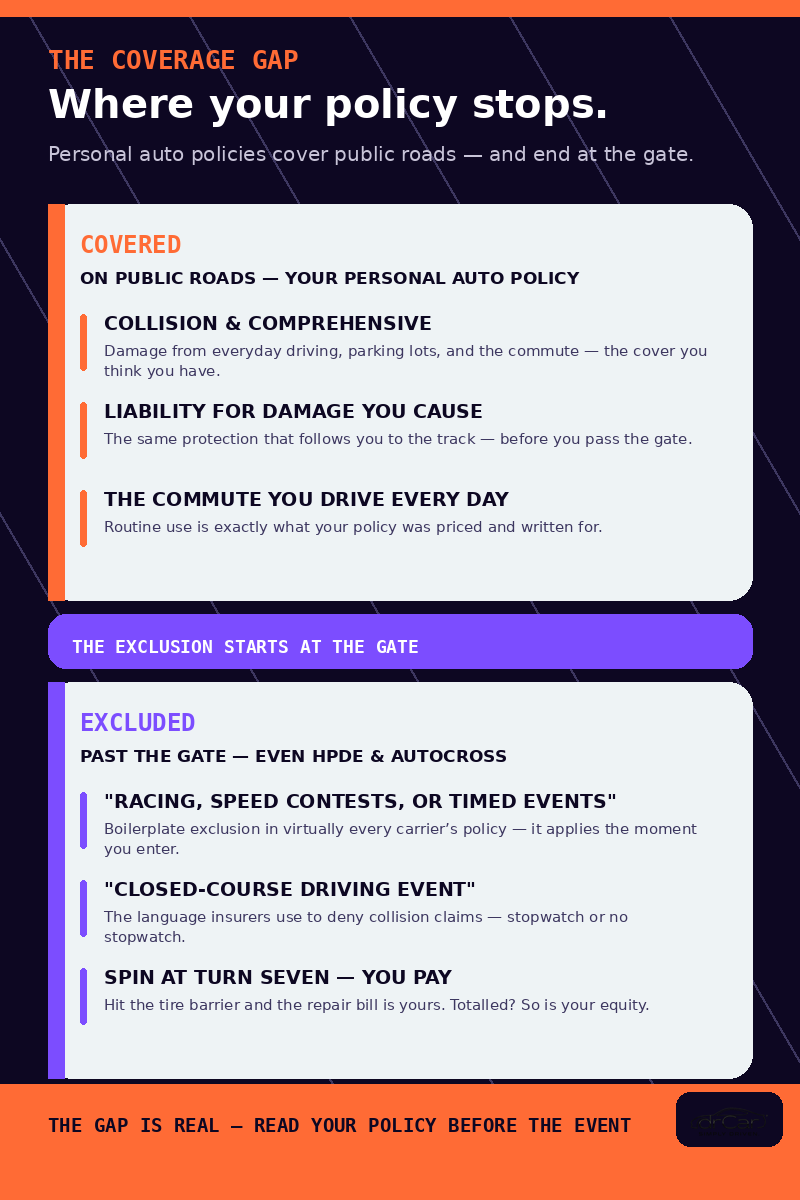
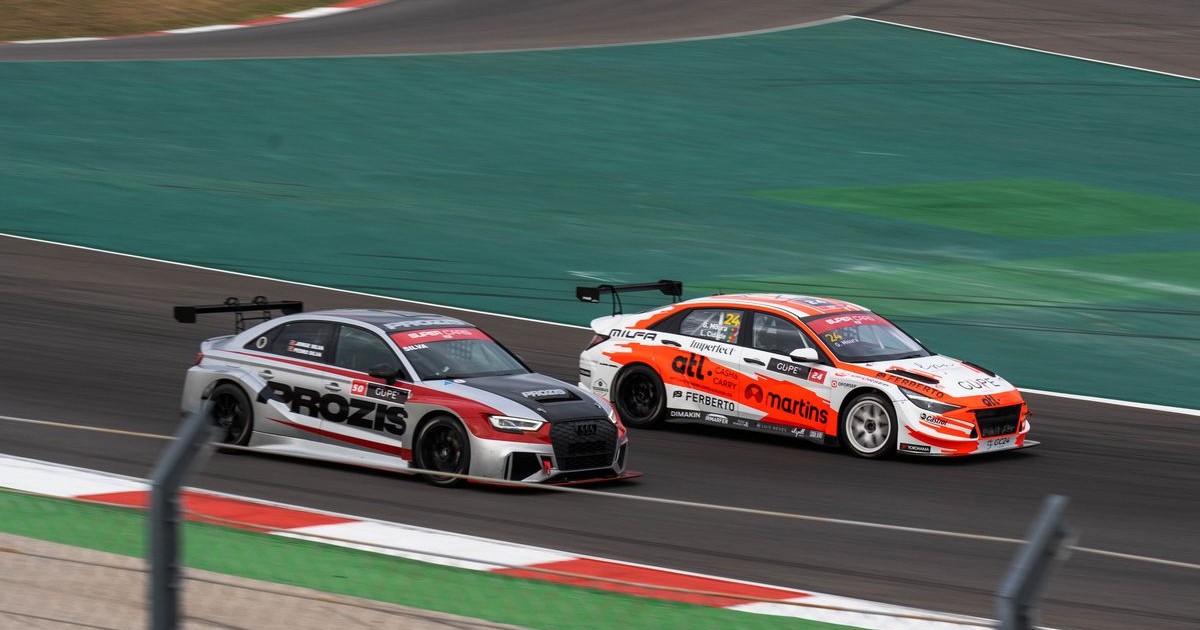
Personal auto policies are written for public roads and ordinary use. Virtually every major carrier includes language that excludes coverage for vehicles used in “racing, speed contests, or timed events.” The language varies by insurer, but the intent is consistent: once you enter an organized event at a closed circuit, your comprehensive and collision coverage stops.
That exclusion applies even if your event is not a race. HPDE (High Performance Driving Education) events are instructional, not competitive. Autocross is autocross — no timed laps around a purpose-built track. Drivers often assume the non-competitive nature of their event exempts them from the exclusion. It usually doesn’t. Many carriers read “closed-course driving event” as sufficient grounds to deny a collision claim, regardless of whether a stopwatch was involved.
The practical consequence: if you spin into a tire barrier at turn seven, the repair bill is yours. Entirely. And if your $45,000 sports car is totaled, so is your equity in it.
What Track Day Insurance Actually Covers
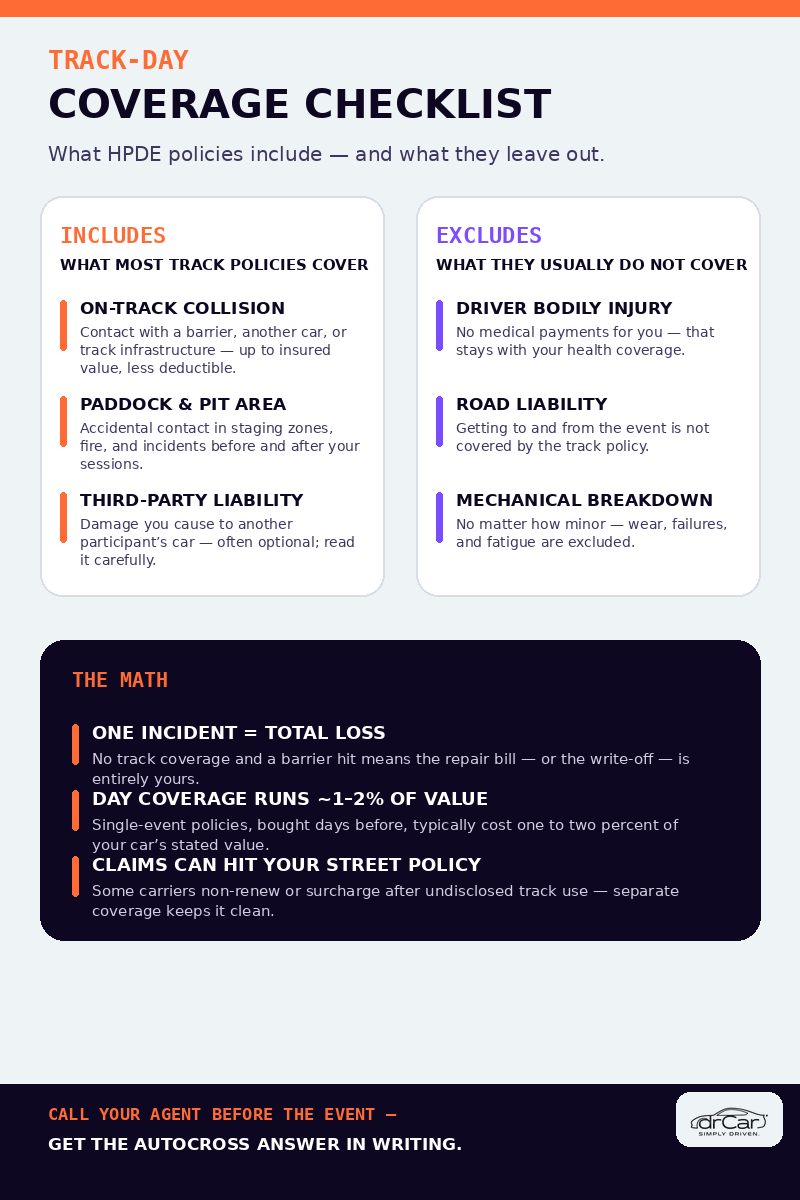
The track-day insurance market exists specifically to fill this gap. Policies vary, but the core coverage typically includes:
On-track collision coverage. This is what most drivers need most. If you make contact with a barrier, another car, or track infrastructure during your session, an HPDE-specific policy covers the physical damage to your vehicle up to the insured value — less any deductible.
Paddock coverage. Damage doesn’t only happen on track. Coverage that extends to the paddock and pit area protects against accidental contact in staging zones, fire, and other incidents before and after your sessions.
Third-party liability. Some track-day policies include or offer coverage for damage caused to another participant’s vehicle. This is less common and worth reading carefully — many HPDE events require participants to sign waivers accepting sole responsibility for their own vehicles, but a liability rider can still be valuable.
What most track policies do not cover: bodily injury to the driver (medical payments), road liability on the way to the event, and mechanical breakdown. Read the exclusions before you buy.
Autocross: A Different Animal
Autocross sits in a slightly different category. Participants drive individually through a timed cone course, rarely reaching high speeds, and the risk profile is far lower than a road-course HPDE. Some insurers have historically been more lenient about autocross claims — but “historically” is not “guaranteed,” and policy language controls, not informal precedent.
If your insurer’s policy explicitly excludes “timed events” or “closed-course events,” an autocross is likely excluded. The straightforward approach is to call your agent before the event, ask directly whether autocross is covered, and get the answer in writing. If the answer is no or uncertain, day coverage through a short-term motorsport policy is inexpensive enough that the question answers itself.
How to Get Covered
Short-term track-day insurance. Several specialty insurers offer event-by-event coverage that you purchase days or hours before your event. Policies are typically priced as a percentage of your vehicle’s stated value — often in the range of one to two percent per event day — with deductibles ranging from a few hundred dollars upward depending on vehicle value and coverage tier. Providers worth researching include Lockton Motorsport (formerly American Collectors), Markel, and Track Day Insurance.
Annual track-day endorsements. If you attend multiple events per year, some carriers offer a season-long endorsement that covers all HPDE events for a flat annual premium. This is generally more economical than buying single-event coverage for every outing.
Dedicated motorsport policies. For drivers with purpose-built or significantly modified track vehicles, a standalone motorsport policy — rather than an endorsement on a street-car policy — may be the appropriate product. These are written by specialty markets and can accommodate agreed-value coverage, which matters when a modified vehicle has depreciated from its street value but appreciated from the cost of its upgrades. It’s the same valuation discipline that guides evaluating a neglected classic before you commit, and it’s why cars crossing the 30-year classic line are often insured for far more than their book value.
The Daily Driver Policy Risk
There is a second coverage problem that drivers overlook: what happens to your regular auto policy if you file a claim after an on-track incident and your insurer discovers you were at a track event?
Beyond denying the claim, some carriers have used undisclosed track use as grounds to non-renew or surcharge a policy. It is not a universal practice, and it is not a guaranteed outcome — but it is a real risk. Purchasing separate track coverage isn’t only about protecting your car on the day. It’s also a structural decision that keeps your on-track activity cleanly separated from the personal auto policy that covers your commute.
Before Your Next Event
The administrative lift is small. A five-minute call to your auto insurer before your first event confirms exactly where your coverage ends. A short-term policy from a specialty carrier picked up in the week before the event fills the gap for a predictable, modest cost.
If you’re not driving at this event, getting trackside without owning a race car is a low-pressure way to learn how an event weekend flows before your first HPDE.
The math is not complicated: one serious incident without track coverage can represent a total loss. One season of short-term track policies, even at several events, typically costs a fraction of a collision repair — and a small fraction of a replacement vehicle.
Track driving rewards preparation. Checking your coverage is the same discipline as checking your tire pressures and your fluid levels. The corner doesn’t know whether you planned ahead. Your insurer does.
Heading to an event soon? Ask DrCar whether your policy covers that on-track moment — and get pointed toward the right coverage before you buckle in.