

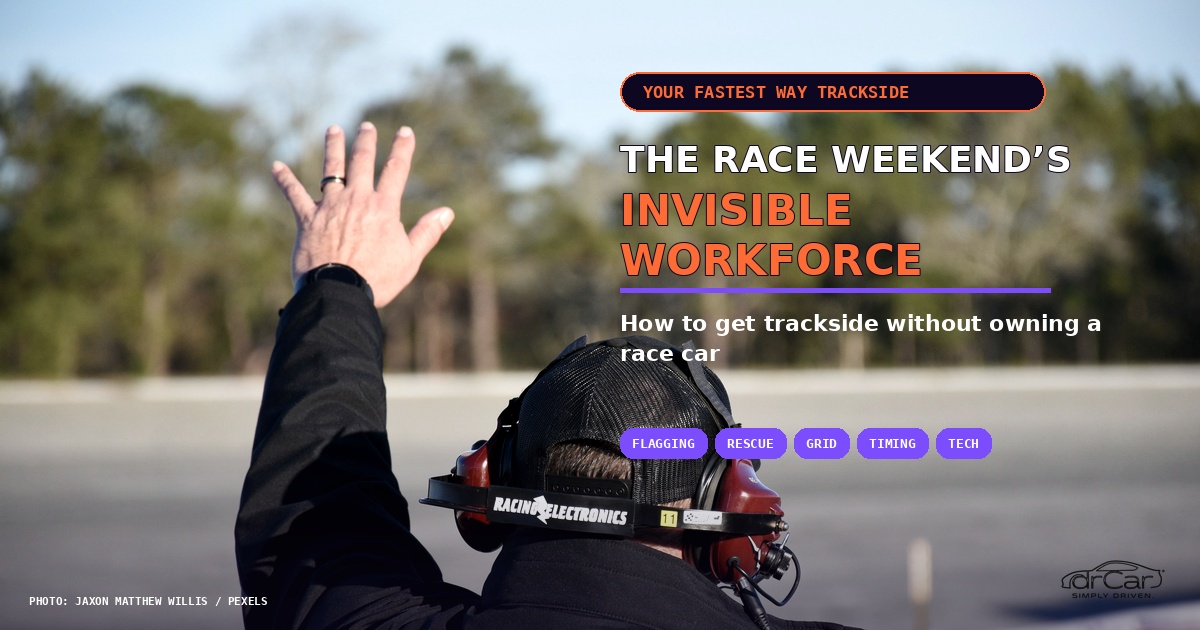
Race track volunteering doesn’t require a helmet, a transponder, or a $40,000 race-prepped car. To stand at the edge of the arena, you just need to show up.
Race track volunteering means helping organize, officiate, communicate, inspect, or respond at a motorsport event without entering a race car. Start by finding a local club, contacting its worker coordinator, completing basic safety training, attending an event with an experienced crew, and earning credentials in your chosen specialty.
Every regional race weekend you’ve ever attended ran because of people you probably never noticed. They stood at corner stations in orange vests as cars slid wide and caught traction again. They radioed timing from the start-finish line. They pulled a driver out of a cockpit before the fire reached the fuel cell. They handed out the trophies, chalked the grid squares, and packed everything back into a trailer at 7 PM on Sunday — then started counting the days until the next event.
They are the invisible workforce of grassroots motorsport. And race track volunteering is the easiest way in.
Why Race Track Volunteering Is the Real Entry Point
Racing culture projects a romantic image: the driver, the machine, the podium. But for every car on track, three to five volunteers are holding the weekend together. SCCA regional events, NASA club days, IMSA grassroots series — none of them run without a full complement of officials, corner workers, and emergency crews.
The cost barrier to driving is real. Entry fees, car prep, tires, towing, licensing school — you’re looking at thousands of dollars before the green flag drops. The cost barrier to race track volunteering is a safety course, a weekend of your time, and the willingness to learn.
The access you receive in return is extraordinary.
Take Sheila Kowalczyk of SCCA’s Milwaukee Region. She logged her first corner assignment in 1991 — a regional autocross that needed bodies, and she had a Saturday free. Thirty-five years later, she has worked rescue and recovery at Road America, flagged multiple Runoffs classes, and cross-trained through communications, pit lane, and technical inspection. She’s seen more of racing’s machinery, politics, and beauty than most drivers ever will.
"You learn to read a race from the outside," she says. "Drivers feel it. We see it."
The Specialties: Finding Your Corner
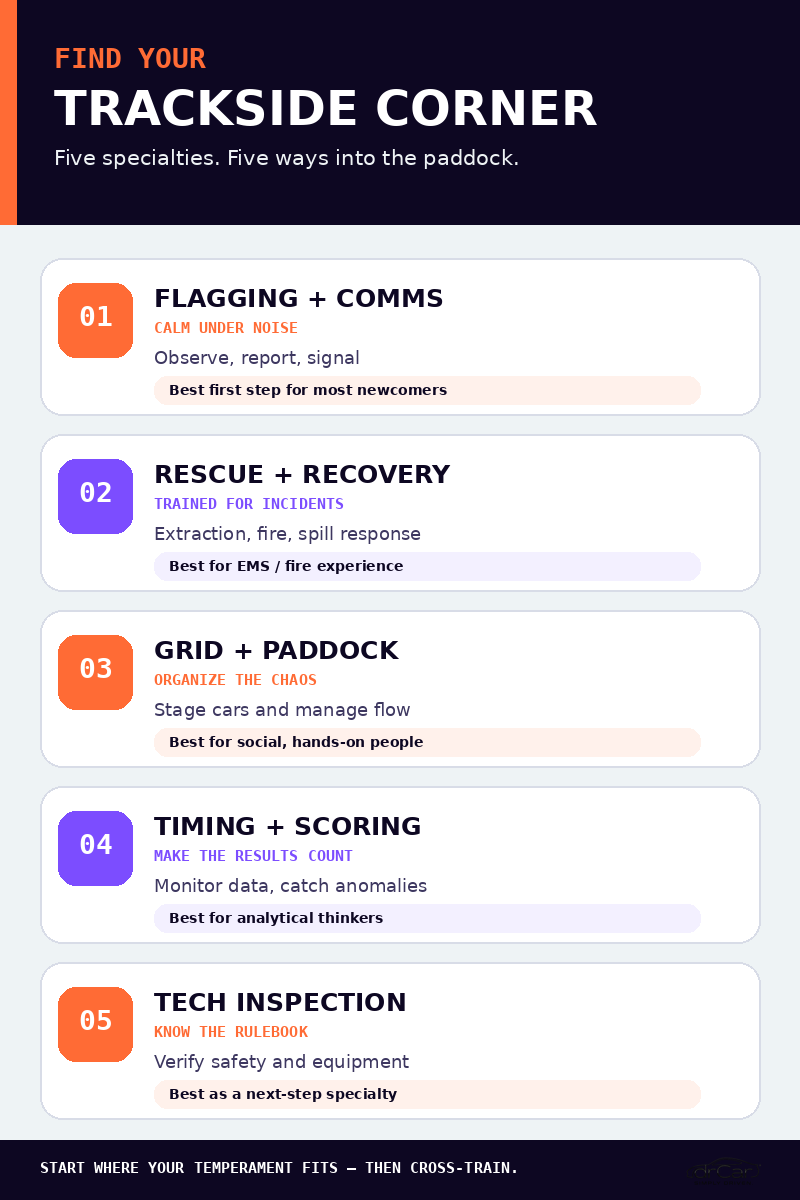
Not every volunteer role looks the same. The ecosystem is wide, and most clubs encourage cross-training once you’ve found your footing.
Flagging and Communications (F&C)
This is where most volunteers start. Corner workers are the nerve endings of the track — they observe, report, and signal simultaneously. A yellow flag held steady versus waved. A blue flag for a faster car approaching. The white flag for an emergency vehicle on course. A red flag that ends the session.
The job demands calm under noise, spatial awareness, and flawless radio discipline. SCCA F&C is nationally credentialed; your regional training transfers to any sanctioned event in the country. Basic weekend training covers flag protocols, station safety, debris assessment, and communication structure.
The corner station is also the best seat in the house. Unfiltered. Unmediated. Right there. Reading a developing slide also gives you a trackside view of the physics behind controlled drift.
Emergency Services (Rescue and Recovery)
This specialty carries the highest responsibility — and the steepest training curve. Rescue workers extract drivers from damaged cars, contain fuel spills, and coordinate with corner stations and race control during incidents. Most regions require a current first aid certification before training begins, and dedicated fire suppression courses are standard.
The Milwaukee Region runs its emergency crew as a cohesive unit; members train together in the off-season and rotate assignments at events to build redundancy. New volunteers shadow experienced crews for their first several events before working incidents independently.
If you have a background in EMS, firefighting, or military service, your skills translate directly — and clubs want you.
Grid and Paddock
Behind the pit wall, the grid crew manages car staging, starting procedures, and the organized chaos of getting 40 vehicles lined up correctly under time pressure. It’s less technical than F&C but deeply social — this is where you meet drivers, crews, and the full community over a run group.
Grid work suits volunteers who want immersion without the long corner station shifts. Many club members start here and develop relationships that pull them deeper into the program.
Timing and Scoring
Precision work. Timing crews maintain official lap records, verify transponder data, catch scoring anomalies, and produce the results sheets that determine class wins and championship points. Modern clubs run electronic timing systems, so the role has shifted toward data monitoring and error-catching rather than manual stopwatch operation — but the attention to detail requirement has only increased.
If you’re analytically inclined and want to understand race strategy from a data perspective, timing is where the numbers live. The same analytical mindset appears in Ford’s Hypercar engine testing program.
Technical Inspection
Pre-race tech involves verifying that cars meet class safety and equipment requirements — roll cage specs, fire suppression, helmet and suit certification, logbook currency. It requires knowledge of the rulebook and the confidence to send a car back to the paddock when something doesn’t meet the standard.
Most regions train tech inspectors internally over time. It’s a natural next step after volunteering in other roles and developing familiarity with the regulations. The emphasis on documentation also echoes how provenance language shapes classic-car evaluation.
Race Track Volunteering: How to Get Started
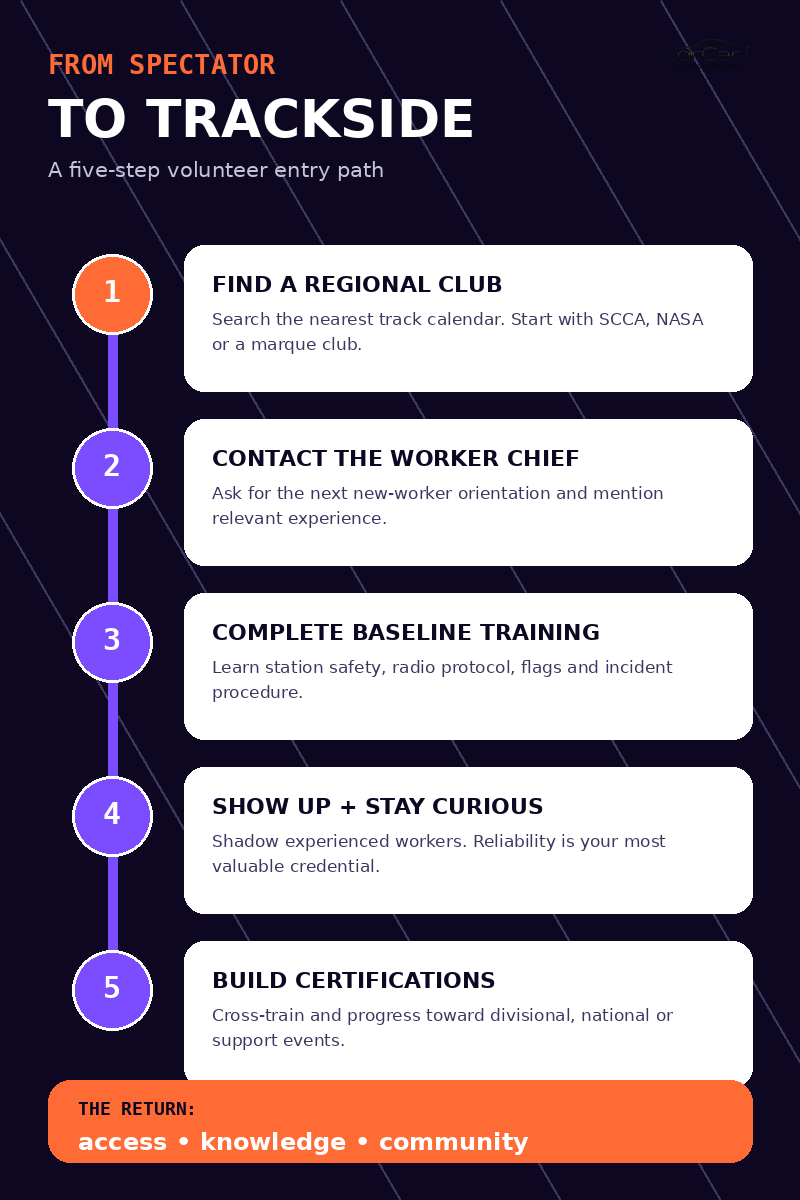
- Find your regional club. SCCA alone has more than 100 regions across the country. NASA, BMWCCA, Porsche Club, and dozens of marque clubs run similar volunteer structures. Search your nearest track’s event calendar and identify the organizing club.
- Contact the Chief of Workers or Chief Steward. Every sanctioned event has a Chief of Workers responsible for corner station staffing. Email or call. Express your interest, mention any relevant background, and ask about the next new worker orientation. Clubs are perpetually short-staffed — your call will be welcomed.
- Complete the baseline training. For SCCA, this means attending a new-worker school (often held the morning of your first event) and completing the flag and communications exam. Some regions offer online orientation in advance. Emergency services requires additional formal coursework.
- Show up and stay curious. Your first event will involve a lot of watching and asking questions. That’s correct. The fastest way to grow is to work alongside experienced volunteers, take every cross-training opportunity offered, and be reliable — because reliability is the currency of every volunteer organization.
- Pursue regional certification. SCCA and similar clubs issue regional worker certifications across specialties. As your credentials accumulate, you become eligible to work higher-profile events — divisional championships, national runoffs, professional support races. The pathway from a local autocross to a national platform is genuinely open to anyone willing to put in the time.
What You Actually Get
The transactional pitch is easy: free track access, close-up machinery, inside knowledge. All of that is real.
But the deeper return is the community.
Motorsport volunteering builds relationships at a density that casual spectatorship never does. You work through rain delays and red-flag situations with the same group of people, season after season. You share the radio channel when someone goes off and comes back uninjured. You celebrate the wins that only workers from that corner station actually saw in full.
Sheila Kowalczyk has watched drivers she flagged on their first laps become national competitors. She’s worked alongside corner workers who became race directors, technical officials, and club presidents. The network she built over 35 years started with a borrowed orange vest and a Saturday morning commitment.
"I came out for one event," she says. "I just never stopped."
The Arena Is Waiting
Racing’s invisible workforce isn’t invisible to each other. They know every corner of every track they’ve worked. They know the stories that never make the live broadcast. They know the difference between a car that’s racing and a car that’s in trouble — because they’ve learned to read both.
Race track volunteering can make you one of them this season. Find your regional club, reach out to the workers’ coordinator, and show up ready to learn. The corner doesn’t care whether you drove to get there or volunteered.
It only cares that you’re ready.
Tell DrCar which trackside specialty you’d try first — flagging, rescue, timing, or grid. Then connect with a local club and share what your first event taught you. The community is built one volunteer at a time.