

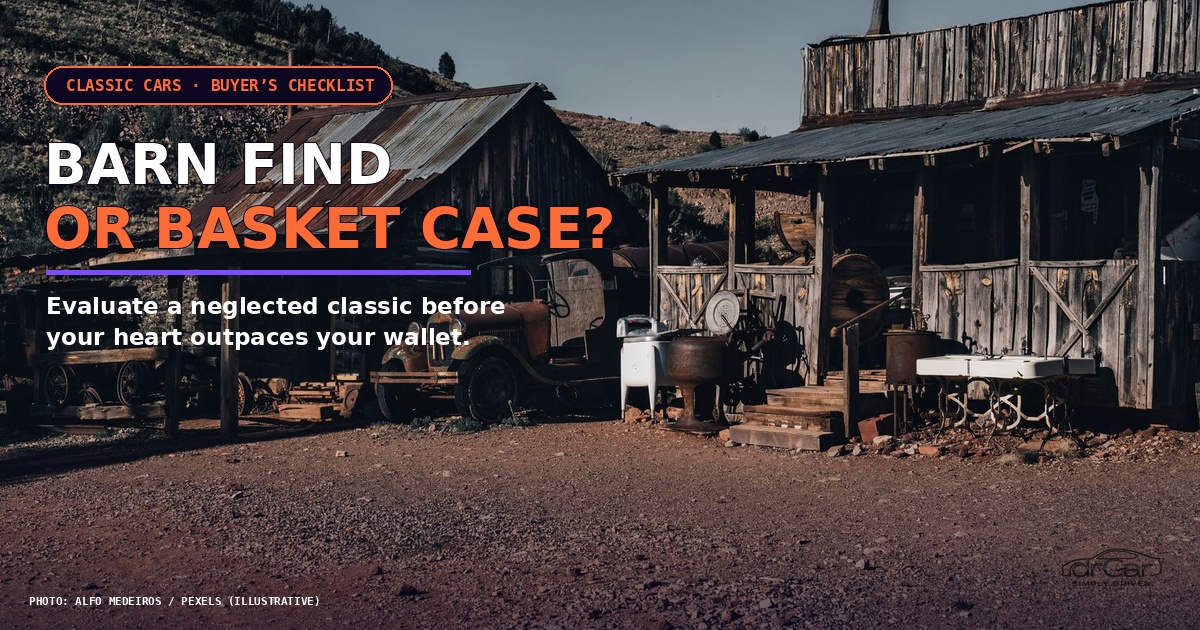
The story always sounds the same: a garage sealed for thirty years, a tarp pulled back, and suddenly you’re staring at a chrome grille and faded paint that once turned heads on a Friday night. The barn find mythology is powerful — and it sells cars. That is exactly why you need a checklist before your heart outpaces your wallet.
Not every dusty classic is a sleeping treasure. Some are just old, tired, and expensive. Separating a genuinely preservable artifact from a money pit requires cold eyes and a structured approach. Here is how to apply both.
Start Before You Arrive: Do Your Homework
Research the model before you drive to see it. Know the production numbers, the known weaknesses, and the parts landscape — and whether the model is a genuine emerging classic or a car whose collectible value peaked years ago. A scarce European grand tourer with orphaned mechanical components is a fundamentally different proposition than a popular American muscle car still supported by a thriving reproduction industry.
Call the seller in advance. Ask the direct questions that will rule the car in or out immediately:
- Does it have a clear title in the seller’s name?
- Is it complete, or have parts been removed over the years?
- Has it been started recently, or is the engine seized?
A seller who cannot answer those three questions — or hedges on any of them — is telling you something important before you invest travel time.
The Title: Non-Negotiable
A car without a clean, transferable title is not a bargain at any price unless you have significant experience navigating your state’s bonded title or Vermont registration workarounds. Lost titles, bill-of-sale-only situations, and estate sales without probate clearance can strand a restoration investment in legal limbo for months.
Verify that the VIN on the title matches the dash, the door jamb, and — if present — the frame stamp. Discrepancies are immediate grounds to walk. On a legitimate barn find, those numbers should tell a consistent story. For vehicles with international significance, supporting documentation such as a FIVA ID card can help substantiate the car’s identity and provenance.
Rust: The Only Number That Matters
You can rebuild an engine. You cannot economically rebuild the structure of a car whose floor pans, frame rails, and rocker panels have dissolved from the inside out.
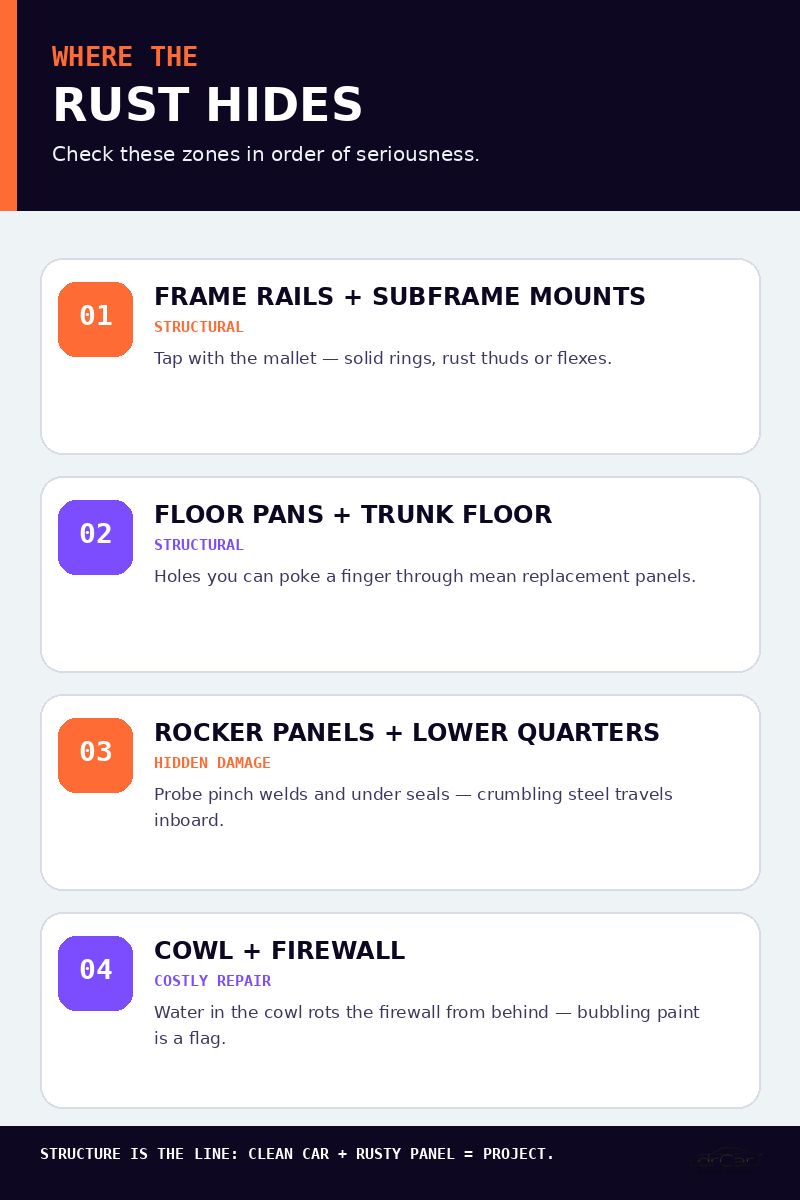
Bring a flashlight, a telescoping magnet, and a wooden dowel or rubber mallet. Check these areas in order of seriousness:
Frame rails and subframe mounts. These are structural. Perforation here means a professional restoration becomes a fabrication job. Tap with the mallet — solid steel rings; rust-compromised steel thuds or flexes.
Floor pans and trunk floor. Lay on your back and look up. Surface rust that has not yet perforated is workable. Holes you can poke a finger through mean replacement panels — budget accordingly.
Rocker panels and lower quarters. The worst rust tends to hide behind trim, under rubber seals, and inside pinch welds. Probe the corners. If the metal crumbles rather than dents, the damage has likely traveled further inboard than the visible surface suggests.
Cowl and firewall. Water that collects in the cowl vent area can rot the firewall from behind. Open the hood and look at where the firewall meets the cowl — bubbling paint or soft metal here is a costly repair on most body-on-frame and unibody cars alike.
A car with clean structure but bad paint is a project. A car with compromised structure is an investment-grade money trap disguised as a deal.
Mechanical Condition: What You Can Evaluate Without Starting It
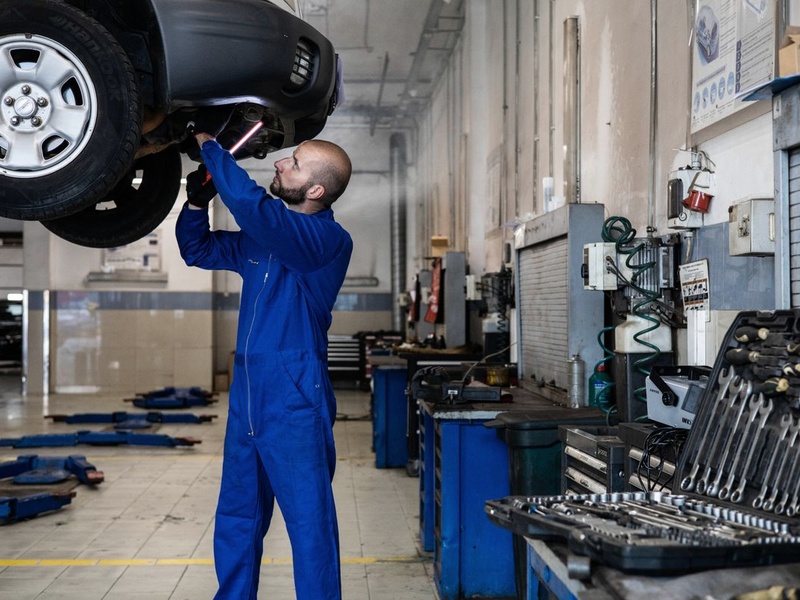
A seized engine is not automatically a dealbreaker, but it narrows the economics considerably. Remove the spark plugs and attempt to rotate the crankshaft by hand at the harmonic balancer. Some resistance is normal after years of sitting; complete immobility with no give suggests hydrolocked cylinders, a spun bearing, or a rust-welded bottom end.
Check the oil filler cap and dipstick for milky residue — a sign of coolant intrusion. Inspect the radiator and coolant hoses for collapse, cracking, or complete deterioration. Look at the brake master cylinder reservoir for fluid that has turned to gel or separated.
None of these findings necessarily kill a deal, but each one adds to the realistic restoration budget. The goal at this stage is honesty, not optimism.
Completeness: Parts You Cannot Buy
For most popular classics, reproduction vendors have solved the body, trim, and interior equation. The parts you need to account for are the ones that no one reproduces: correct-date-coded engines and transmissions for numbers-matching cars, factory options that distinguish one trim from another, and obscure interior or electrical components for lower-production variants.
Walk the car systematically. Under the hood — is the engine the correct unit for the VIN, or has it been swapped? Inside — are the dash, door panels, and seats present, even if damaged? In the trunk — is the spare, jack, and any factory documentation still there? Missing pieces from the interior or drivetrain are not merely cosmetic problems; on a numbers-matching classic, they are the difference between an investment-grade restoration and a driver-quality rebuild.
Pricing the Project Realistically
The only way to know whether the asking price is fair is to build a restoration budget before you negotiate. Get quotes — not estimates, but actual quotes — on the work the car visibly needs. Then add a contingency of at least twenty-five percent, because every neglected classic reveals surprises once disassembly begins.
Research recent auction results for comparable cars in finished condition. Work backward from that number: subtract your total restoration cost, subtract your desired margin or the premium you place on personal satisfaction, and you have your maximum offer. If the seller’s ask exceeds that number, it is not a deal no matter how good the car looks under the tarp.
A comprehensive agreed-value insurance policy lined up before the restoration begins protects that investment from the first day you take title — not just the day it leaves the shop.
Knowing When to Walk
The hardest skill in classic car buying is recognizing a no. Rotted structure, missing numbers-matching components, a clouded title, and an asking price that leaves no room for the inevitable surprises are each sufficient reasons to pass. Together, they are a clear answer.
There will be another barn find. The cars that test your discipline are the ones that keep you from finding the right one.
The Barn Find Evaluation Checklist
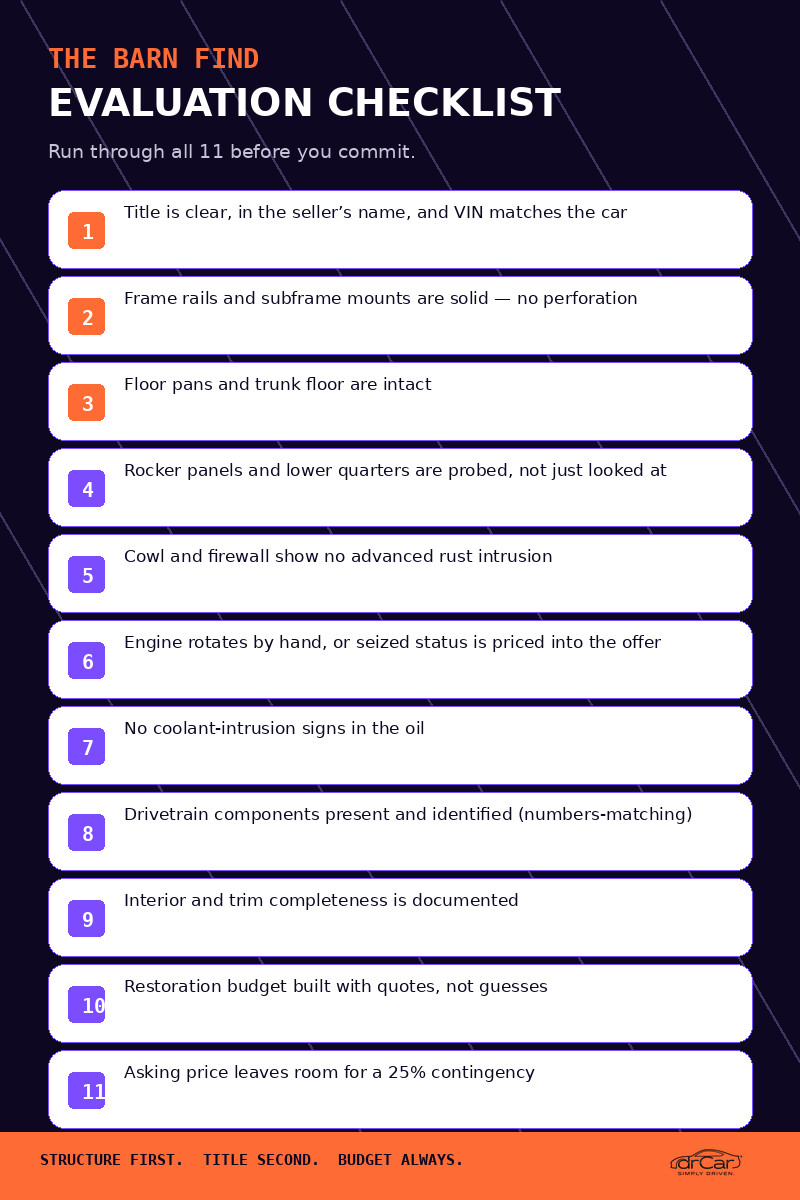
Use this before you commit to anything:
- [ ] Title is clear, in seller’s name, and VIN matches the car
- [ ] Frame rails and subframe mounts are solid — no perforation
- [ ] Floor pans and trunk floor are intact
- [ ] Rocker panels and lower quarters are probed, not just visually checked
- [ ] Cowl and firewall show no advanced rust intrusion
- [ ] Engine rotates by hand or seized status is priced into offer
- [ ] No coolant intrusion signs in oil
- [ ] All major drivetrain components are present and identified
- [ ] Interior and trim completeness is documented
- [ ] Restoration budget is built with quotes, not guesses
- [ ] Asking price leaves room for a 25% contingency and still makes sense
Found a hidden classic? Post its story and your find-or-fix decision on DrCar. The community has seen the cars that fooled everyone — and the ones that were exactly what they appeared to be. Bring your find to a cruise night like Cruisin’ Grand and let other enthusiasts weigh in.